How to Keep Your Brand Voice Consistent Across Channels
To keep your brand voice consistent, write it down once, then train every AI and every person from that same document — rather than setting up each channel separately. Most brands break consistency at the setup stage: a chatbot trained on one thing, a social scheduler on another, an email tool on a third.
This guide covers how to write your brand voice down, how to train AI on it once, and how to keep it intact across chat, WhatsApp, social, email and the phone.
Table of Contents
What is brand voice, and why does it break?
Brand voice is the personality your business has in words. It is how you say things — the vocabulary, the rhythm, the level of formality, the jokes you would and would not make.
It is not what you look like. Your logo, colours and fonts are your visual identity, which is a separate problem with separate tools. This guide is about words.
Brand voice vs brand tone vs brand personality
These three get used interchangeably, which causes half the confusion in this topic.
| What it is | Does it change? | |
|---|---|---|
| Brand personality | The traits behind the brand — warm, precise, irreverent | Never |
| Brand voice | How those traits show up in words | Never |
| Brand tone | How the voice adjusts to the situation | Yes, always |
Think of a person you know well. Their personality does not change. But they speak differently at a funeral than at a barbecue. Same voice, different tone.
That distinction is the whole trick. Your voice stays fixed. Your tone flexes. A brand that sounds formal on LinkedIn and casual on Instagram is doing this correctly. A brand that sounds warm in chat and robotic in email is broken.
The five places brand voice breaks
In practice, consistency falls apart in the same five spots:
1. Between channels. Your website chat sounds one way, your Instagram DMs another, your invoice emails a third — because different tools were set up by different people at different times.
2. Between people. Two team members answering the same question sound like two different companies. Nobody wrote the voice down, so everyone improvises.
3. Between languages. A message translated word-for-word loses its personality entirely. Warmth does not survive machine translation.
4. After hours. Your daytime replies are considered and human. Your 11pm auto-reply sounds like a parking meter.
5. As you grow. The founder’s voice was the brand voice. Then you hired three people and nobody documented what it actually was.
Why AI made this harder, not easier
Here is the uncomfortable part. AI was supposed to solve consistency, and for a lot of businesses it made things worse.
The reason is structural. Most businesses now run several AI tools, each trained separately. A chatbot trained on your website. A social scheduler with its own tone setting. An email tool with a different prompt. An AI writer with custom instructions someone typed once and forgot.
Each one is individually fine. Together they are four slightly different versions of your brand, and the differences compound every time someone updates one and not the others.
Reviewers of popular chat platforms flag this repeatedly — one common criticism of ManyChat is that you have to create separate messages for each channel, and another platform requires building a separate chatbot per channel entirely. That is not a bug in those tools; it is how per-channel architecture works. But it does mean your brand voice lives in four places at once.
The fix is not better prompts. It is fewer sources of truth.
Step 1 — Write your brand voice down
This is the free step, it takes an afternoon, and skipping it is why most brand voice projects fail. No tool can enforce a voice you have not defined.
The one-page brand voice document
One page. Not a 40-slide deck nobody opens.
Include exactly five things:
1. Three personality traits, with limits. Not “friendly” — that means nothing. Write “warm, but not chummy.” “Direct, but never blunt.” “Playful, but never silly about money.” The limit is the useful half.
2. Your reading level. Decide it explicitly. Most businesses should aim for something a twelve-year-old could follow, because clarity reads as confidence and jargon reads as hiding.
3. Words you use. Your actual vocabulary for your product, your customers, your process. If you say “members” not “users,” write that down.
4. Words you never use. This is the most valuable list in the document and the one people skip. Every industry has words that make customers wince.
5. One example of each channel. A good chat reply. A good email. A good social post. Examples teach voice faster than adjectives do.
The “we say / we don’t say” table
Build this table and hand it to every person and every AI. It is the single most useful artifact in brand voice work because it is unambiguous.
| Situation | We say | We don’t say |
|---|---|---|
| Greeting | “Hi — what can I help with?” | “Greetings! How may I assist you today?” |
| Don’t know the answer | “Let me check that and come back to you.” | “That information is unavailable at this time.” |
| Something went wrong | “That’s on us. Here’s how we’ll fix it.” | “We apologise for any inconvenience caused.” |
| Pricing question | “Plans start at X — here’s what’s included.” | “Pricing varies. Contact sales for a quote.” |
| Saying no | “We can’t do that, but here’s what we can do.” | “Unfortunately that is not possible.” |
Ten to fifteen rows covers most of what any business says. Write your own — the pattern matters more than my examples.
Do this first: write the document before you touch any software. It costs nothing and it is what every later step depends on.
Step 2 — Audit where your brand actually speaks
Most businesses underestimate this by half. Make a list of every place words go out with your name on them.
Typical list for a small business:
- Website chat widget
- Instagram and Facebook DMs
- Telegram
- Email — both marketing and transactional
- Social media posts
- Your phone line, including the voicemail message and any AI answering it
- SMS
- Invoices, receipts and shipping notifications
- Review responses
- Your help centre and FAQs
Now go and read the last five real messages from each. Not what you think they say — the actual messages.
Two things usually surface. Transactional emails — order confirmations, password resets, receipts — are almost always off-voice, because they were written once by whoever set up the system. And the after-hours auto-reply is usually the worst-sounding message your brand sends, while also being the one that reaches people at their most frustrated.
Step 3 — Train AI once, not once per channel
This is the step that decides whether consistency holds.
The one-knowledge-base principle
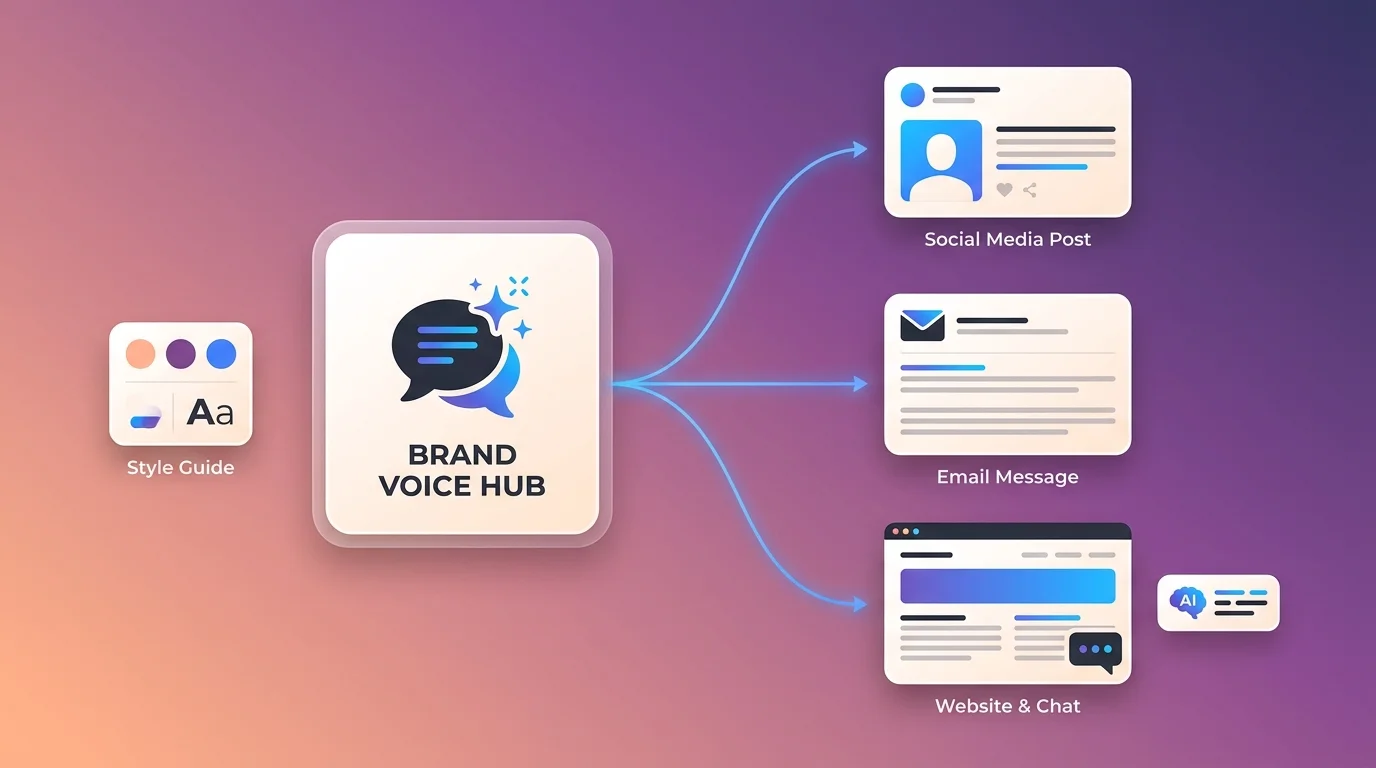
The architecture you want is simple: one trained source of truth, feeding every channel.
| Per-channel setup | One knowledge base | |
|---|---|---|
| Where the voice lives | 4–6 separate tools | One place |
| Updating your returns policy | Edit it 4–6 times | Edit once |
| Adding a new channel | Rebuild from scratch | Already knows your brand |
| Risk of drift | High, and compounds | Low |
| Adding a language | Retranslate per tool | Once, everywhere |
The difference shows up most clearly when something changes. Change your shipping times and a per-channel setup needs four edits — and whoever forgets the fourth one has just created an inconsistency that will contradict the other three to a real customer.
What to feed it: your website, your policy pages, your FAQs, your one-page voice document and your “we say / we don’t say” table. That last one matters more than people expect — an AI given explicit examples of what not to say produces noticeably better output than one given adjectives.
Where Markleyo fits, and where it doesn’t. This is the specific thing Markleyo AI is built around: one knowledge base powering a website chatbot, WhatsApp, Telegram, Instagram, Messenger, an AI phone agent, social posts and written copy — all trained once, answering in 70+ languages, from $14.50/month flat. Train your brand once and every channel inherits it.
What it is not is a brand asset manager. If your problem is logo files, colour codes, version control and pre-approved templates, that is visual identity and you want a dedicated brand asset platform like BrandKity, Frontify or Bynder. Different problem, different tool. This guide is about words.
See the Markleyo AI chatbot page, the AI writer, or the pricing page.
Why per-channel setup breaks consistency
If you are staying with separate tools — which is completely reasonable — do these three things:
Keep one master document and paste it everywhere. Your voice document is the source; each tool gets a copy. Never edit a tool’s prompt directly, or the copy becomes the original.
Version it with a date. “Brand voice v3 — 12 August 2026” at the top. When something sounds wrong you can tell which tools are stale.
Set a re-sync reminder. Monthly, paste the current document into every tool. Ten minutes, and it is the only thing standing between you and slow drift.
Step 4 — Set tone rules per channel without changing your voice
Consistency does not mean identical. It means recognisable.
Here is a practical tone map. Voice constant, tone adjusted:
| Channel | Tone | Length | Emoji? |
|---|---|---|---|
| Website chat | Helpful, quick | 1–2 sentences | Rarely |
| Warm, conversational | Short, like texting | Sparingly | |
| Instagram DMs | Casual, friendly | Very short | Yes |
| Telegram | Direct, informative | Short to medium | Occasionally |
| Marketing email | Considered, useful | Medium | No |
| Transactional email | Clear, reassuring | Short | No |
| Phone / AI voice agent | Calm, unhurried, clear | Full sentences | N/A |
| Social posts | Confident, on-topic | Platform-appropriate | Platform-appropriate |
| Review responses | Gracious, specific, human | 2–3 sentences | No |
The voice test: strip your logo off a message and hand it to a customer. Could they tell it was you? If yes, your voice held. If it could be any company, your tone flexed too far.
A note on the phone specifically, because it is where most brands have no plan at all. If an AI answers your calls, it needs the same voice document as your chatbot — but written for speech. Spoken language uses shorter sentences, no bullet points, and no phrases nobody says out loud. Read your phone script aloud. If you stumble, rewrite it.
Step 5 — Handle multiple languages without losing your voice
This is where brand voice most often dies, and almost nobody plans for it.
The problem: translation preserves meaning and destroys personality. “That’s on us — here’s how we’ll fix it” translated literally becomes stiff and formal in most languages. Your warm brand is now a bureaucratic one, and you will never notice because you do not read that language.
Three approaches, in ascending order of quality:
1. Machine translation of finished copy. Cheapest, worst. Meaning survives, voice does not.
2. AI trained on your voice, generating natively in each language. Better, because it writes in the target language rather than converting into it. This is what multilingual AI agents do when trained properly — Markleyo handles 70+ languages from one knowledge base for exactly this reason, and reviewers repeatedly criticise competing platforms for making multilingual setup painful.
3. A native speaker adapting your voice document per language. Best, and worth it for your top two or three markets. Ask them one question: “what would a warm, direct local business sound like here?” Some of your rules will not transfer — humour rarely does, and formality expectations differ sharply between markets.
A practical minimum: have a native speaker read ten of your automated messages in each major language. It takes them twenty minutes and it catches the worst of it.
Step 6 — Check consistency monthly
Brand voice drifts quietly. Fifteen minutes a month prevents it.
The monthly check:
- Pull five real messages from each active channel. Real ones, not templates.
- Read them in one sitting. Drift is obvious in sequence and invisible one at a time.
- Score each against your voice document. On voice, off voice, or borderline.
- Fix the source, not the message. An off-voice reply usually means a stale knowledge base or an unclear policy page. Fixing the page fixes every future reply.
- Re-sync your voice document into every tool that has its own copy.
One thing to add to your calendar: re-read your transactional emails and after-hours auto-replies every quarter. They are the messages you never see and your customers see most.
Tools that keep brand voice consistent (with pricing)
Brand voice is mostly a documentation problem, so start with the free options and add software only where it earns its place.
| Tool | Cost | What it does for voice |
|---|---|---|
| A written voice document | $0 | The foundation. Nothing works without it |
| Google Docs or Notion | Free | Hosts the document, tracks versions |
| Markleyo AI | From $14.50/mo flat | One knowledge base across chat, WhatsApp, Telegram, social, copy and phone, in 70+ languages |
| Grammarly Business | Per seat | Enforces a written style guide across your team’s writing |
| Jasper | Per seat | Brand voice profiles for marketing copy |
| Buffer or Hootsuite | From low monthly tiers | Scheduling with shared guidelines; voice still set per user |
| ChatGPT or Claude Projects | Free tier upward | Custom instructions holding your voice document for ad-hoc writing |
| BrandKity, Frontify, Bynder | Varies | Visual identity — logos, colours, templates. Not voice |
Two honest points about this table.
First, the $0 row does most of the work. A clear one-page document pasted into whatever tools you already own beats expensive software with a vague brief. If you only do one thing from this guide, do that.
Second, tools do not create a voice. They replicate whatever you gave them. An AI trained on a vague document produces vague copy consistently, which is worse than inconsistent good copy.
Common mistakes that destroy brand voice
Writing adjectives instead of examples. “Friendly and professional” describes almost every business on earth. Two sample replies teach more than ten adjectives.
Skipping the “words we never use” list. It is the fastest quality win available and the most commonly skipped step.
Letting each tool own its own voice. The moment a tool’s prompt becomes the master copy, you have lost central control.
Forgetting transactional messages. Order confirmations, receipts and password resets are read by everyone and reviewed by no one.
Ignoring the after-hours reply. It reaches people when they are most frustrated and it is usually your coldest-sounding message.
Translating instead of adapting. Your voice does not survive literal translation into any language.
Confusing voice with visual identity. They need different documents and different tools. A brand asset manager will not fix how you sound, and a chatbot will not manage your logo files.
Setting it and forgetting it. Policies change, offers change, people leave. A voice document written once and never revisited becomes wrong within a year.
Frequently Asked Questions About Brand Voice Consistent
What is brand voice consistency?
Brand voice consistency means your business sounds recognisably like itself everywhere it speaks — website chat, WhatsApp, email, social posts, the phone. It does not mean identical wording everywhere. Your voice stays fixed while your tone adjusts to each channel, so an Instagram DM can be shorter and more casual than a marketing email while still clearly coming from the same company.
How do I keep my brand voice consistent across channels?
Four steps. Write a one-page voice document with three personality traits, your reading level, words you use, words you never use, and one example per channel. Audit every place your brand sends words, including transactional emails and after-hours replies. Train from one source of truth rather than setting up each tool separately. Then review five real messages per channel monthly and fix the source rather than the individual message.
Can AI maintain a brand voice?
Yes, if you train it properly, and the training matters far more than the tool. Give it explicit examples rather than adjectives — a “we say / we don’t say” table produces noticeably better results than “be friendly and professional.” The bigger risk is architectural: running four AI tools each trained separately gives you four slightly different brand voices that drift further apart over time. One knowledge base feeding every channel avoids that.
What is the difference between brand voice and brand tone?
Brand voice is your fixed personality in words — it never changes. Brand tone is how that voice adapts to the situation, and it changes constantly. The same brand should sound briefer in an Instagram DM than in a considered email, and calmer on a complaint call than in a launch announcement. Voice constant, tone flexible. Getting this backwards is why some brands feel scattered and others feel stiff.
How do I keep brand voice consistent in other languages?
Do not translate finished copy — it preserves meaning and destroys personality. Either use AI trained on your voice that generates natively in each language, or have a native speaker adapt your voice document per market. Some rules will not transfer; humour rarely does and formality expectations differ sharply between markets. As a minimum, ask a native speaker to read ten of your automated messages in each major language.
What tools do I need for brand voice consistency?
Less than you would think. A written voice document costs nothing and does most of the work. Beyond that, you want your existing AI tools trained from that one document — or a platform with a single knowledge base feeding every channel, which removes the drift problem structurally. Note that brand asset managers like BrandKity, Frontify and Bynder handle visual identity — logos, colours, templates — not how you sound.
How often should I review my brand voice?
Check five real messages per channel monthly — that takes about fifteen minutes and catches drift early. Re-read your transactional emails and after-hours auto-replies quarterly, since those are the messages you never see and your customers see most. Revisit the voice document itself annually, or whenever your pricing, positioning or team changes significantly.
Does brand voice actually affect sales?
It affects trust, which affects sales. Inconsistency reads as carelessness, and a customer who gets a warm reply in chat and a cold one by email learns that one of them was not really you. The practical case is simpler than the branding case though: a clear voice document makes every automated message better, and better automated messages get more replies. That is worth an afternoon of work regardless of what you believe about branding.
The bottom line
Brand voice consistency is not a software problem. It is a documentation problem that software can help you enforce.
Do these four things in order:
- Write the one-page document. Three traits with limits, reading level, words you use, words you never use, one example per channel. Free, one afternoon.
- Build the “we say / we don’t say” table. Ten to fifteen rows. It is the most useful thing you will write.
- Train from one source, not per channel. Every extra place your voice lives is another place it can drift.
- Check five messages per channel monthly. Fix the source, not the message.
And remember the two things most brands get wrong: your transactional emails and after-hours replies are almost certainly off-voice right now, and they are the messages your customers see most.
Want one brand voice across chat, WhatsApp, Telegram, social and the phone? Start a free Markleyo AI trial — train your brand once and every channel answers the same way, in 70+ languages, from $14.50/month.