How to Train AI to Match Your Brand Voice and Style?
Artificial Intelligence is changing the way brands communicate. From writing blog posts to crafting product descriptions and emails, AI tools, especially the modern AI writer can now generate high-quality content in seconds. To truly stand out, businesses must train AI to match your brand voice ensuring every message sounds authentic, consistent, and uniquely yours.
But there’s a problem, most AI-generated content sounds generic. It lacks the emotional depth, unique tone, and brand personality that make readers feel connected to a company.
That’s where the real challenge begins: training AI to match your brand voice and style.
When you align AI with your unique communication tone, you can create content that feels human, on-brand, and consistent at scale. Whether your brand voice is playful, authoritative, warm, or minimalist, AI can be fine-tuned to mirror that identity with precision.
In this detailed guide, you’ll learn everything you need to know to train AI to match your brand voice. We’ll explore why brand voice matters, how to define it, and how to train AI through voice guides, prompts, and structured feedback loops to achieve consistent, high-quality results.
Table of Contents
Why Brand Voice Consistency Matters in the Age of AI
Your Brand Voice Is Your Identity
Your brand voice represents who you are in written form. It’s how your brand speaks to your audience, reflects its personality, and builds trust. Whether it’s the confident tone of Apple, the friendly warmth of Starbucks, or the playful vibe of Old Spice, voice consistency is what keeps audiences loyal.
Without a consistent voice, your content feels scattered, robotic, and untrustworthy. When AI-generated writing doesn’t match your established tone, it confuses readers and dilutes brand recognition.
How AI Changes the Game
AI allows brands to scale content faster than ever, but it also introduces a new risk: losing your voice in automation. That’s why AI brand voice training is becoming a strategic necessity.
When trained properly, AI can:
- Write blog posts that sound human and fit your tone.
- Draft product descriptions or captions that reflect your style.
- Generate long-form articles that maintain emotional consistency.
- Adapt voice variations for different audiences or platforms.
By teaching AI to write in your brand’s language, you blend efficiency with authenticity which is the perfect formula for modern digital success.
Step 1: Define Your Brand Voice and Style
Before training AI, you must first define what your brand voice actually sounds like. You can’t teach a machine something you haven’t articulated clearly yourself.
Analyze Your Existing Content
Review your top-performing materials i.e., website pages, blogs, emails, and social posts. Look for consistent tone patterns. Identify what makes your brand sound like you.
Ask questions such as:
- Are we formal or conversational?
- Do we use humor or keep it serious?
- Are we more motivational or analytical?
- Do we use industry jargon or plain, simple words?
Describe Your Voice in 3–5 Words
Pick adjectives that summarize your voice. For example:
- Nike: Bold, motivational, action-driven.
- Mailchimp: Playful, quirky, friendly.
- IBM: Formal, authoritative, precise.
- Airbnb: Welcoming, inclusive, warm.
Create a Voice Framework
Write a short statement like:
“Our brand voice is confident but empathetic. We speak like a knowledgeable friend i.e., direct, warm, and respectful. We avoid jargon, keep sentences short, and focus on clarity.”
This framework will serve as the foundation for your AI training and your brand voice guide.
Step 2: Build a Brand Voice Guide for AI
A brand voice guide is your AI’s instruction manual. It translates abstract ideas like tone, rhythm, and emotion into actionable rules the AI can follow.
What to Include in a Brand Voice Guide
- Tone Definition: Clearly describe your desired tone i.e., friendly, formal, witty, or inspirational.
- Personality Traits: Choose traits that reflect your brand persona (trustworthy, fun, bold, etc.).
- Linguistic Rules: Explain vocabulary, punctuation, sentence length, and contractions.
- Emotional Range: Specify the feelings your writing should evoke (comfort, confidence, excitement).
- Dos and Don’ts: Examples of words, phrases, or expressions to use or avoid.
- Real Examples: Add snippets of your best-performing content that perfectly reflect your voice.
Example
| Element | Description |
| Tone | Calm, optimistic, educational |
| Voice Traits | Trustworthy, eco-conscious, friendly |
| Language Rules | Avoid harsh or negative words. Use short sentences. Emphasize “we” over “you.” |
| Do’s | “Together we can create cleaner oceans.” |
| Don’ts | “Pollution is your fault.” |
By clearly documenting these rules, you give your AI writing tools a blueprint to follow.
Step 3: Gather Quality Training Data and Samples
The next step is to feed your AI the right data. Like humans, AI learns best through examples.
Select High-Quality Brand Content
Gather 5–10 samples of your most successful content pieces, ones that truly represent your voice and brand tone. Include blog articles, social posts, email campaigns, or video scripts.
Avoid pieces with mixed tone, outdated language, or inconsistent style.
Clean the Data
Before using the samples:
- Fix grammatical errors.
- Standardize formatting.
- Remove redundant sentences.
- Make sure tone remains consistent throughout.
Your AI should only learn from your best work.
Data Types to Include
- Blog posts and landing pages.
- Brand storytelling articles.
- Social captions and ad copy.
- Customer emails and newsletters.
- Product descriptions or FAQs.
When AI models analyze this data, they identify tone markers, word frequency, rhythm, and emotional cues helping them reproduce your unique brand feel in new writing.
Step 4: Use Smart Prompt Engineering
Prompts are the “commands” that guide your AI. Think of them as instructions that tell your AI what role to play, what tone to adopt, and how to structure the content.
If your prompts are vague, your output will be generic. If they’re detailed, your AI will sound polished and consistent.
Key Elements of a Great Prompt
- Role Definition: Tell the AI who it is (“You are a content writer for XYZ brand”).
- Tone and Style: Mention your desired voice (“Write in a warm, friendly, and confident tone”).
- Audience Context: Identify who the content is for.
- Format and Length: Specify if it’s a blog, caption, or email.
- Special Instructions: Include do’s and don’ts, vocabulary preferences, or structure.
Step 5: Test, Refine, and Reinforce
AI training isn’t a one-time process, it’s iterative. After each batch of content, review and refine.
Quality Testing Checklist
Ask the following:
- Does the output match our tone and emotional feel?
- Does it sound natural and human-like?
- Does it follow sentence and word-choice patterns from our voice guide?
Highlight the strengths and weaknesses of each piece.
Feedback Loop
- Review AI-generated drafts manually.
- Edit the tone, structure, and style where needed.
- Feed the revised version back to your AI (through prompt or retraining).
Over time, the model starts adapting by requiring fewer corrections with each iteration.
Step 6: Scale Your AI Brand Voice Across All Channels
Once your AI reliably mimics your brand tone, apply it across multiple content types.
Multi-Channel Application
- Website: Keep a consistent brand tone across all pages.
- Blog: Make every article feel like it’s written by the same voice.
- Social Media: Adjust tone slightly more playful on Instagram, more professional on LinkedIn.
- Email Campaigns: Maintain warmth and personalization.
- Ad Copy: Keep concise, emotionally resonant messages.
Consistency across all touch-points ensures your audience always recognizes your brand instantly, no matter where they encounter it.
Step 7: Maintain and Update Your Brand Voice
Brands evolve and your voice should too.
Every few months, review your voice guide and AI output. Ask:
- Does our tone still fit our audience?
- Have new trends or platforms changed how we communicate?
- Are there words or phrases that feel outdated?
Voice Governance
Appoint a brand voice manager or content lead to oversee voice integrity.
They should update tone rules, refresh examples, and ensure both humans and AI follow the same guidelines.
You can even create a Voice QA Checklist that every piece of content e.g., human or AI must pass before publishing.
Common Mistakes When Training AI
Even experienced marketers face challenges in brand voice training. Here’s what to avoid:
Not Defining Voice Clearly
AI can’t guess your tone. You must define it explicitly with examples and documentation.
Relying on a Single Prompt
Use multiple variations to train AI across different content types.
Ignoring Human Oversight
Always keep editors or marketers in the loop for quality assurance.
Over-Automation
AI should assist, not replace creativity. Let humans handle emotion-heavy or storytelling content.
Not Refreshing Data
Old data = outdated tone. Refresh your training samples regularly for relevance.
By staying aware of these pitfalls, you’ll ensure your AI voice stays authentic and adaptive.
The Future of AI Brand Voice Training
AI technology is evolving rapidly. In the near future, AI brand voice systems will become smarter and more adaptive than ever.
Emerging Innovations
- Voice Fingerprinting: AI models will analyze your sentence rhythm and vocabulary frequency to perfectly emulate your voice.
- Multi-Persona AI Models: A single AI can switch between tones e.g., formal for B2B, playful for B2C.
- Real-Time Tone Adjustment: AI tools will soon auto-detect and correct tone inconsistencies.
- Brand Voice Validation Tools: Software will analyze content and score it against your brand voice guide.
By staying ahead of these innovations, you can ensure your AI remains an authentic reflection of your brand, not just a content generator.
AI Voice Training in Action
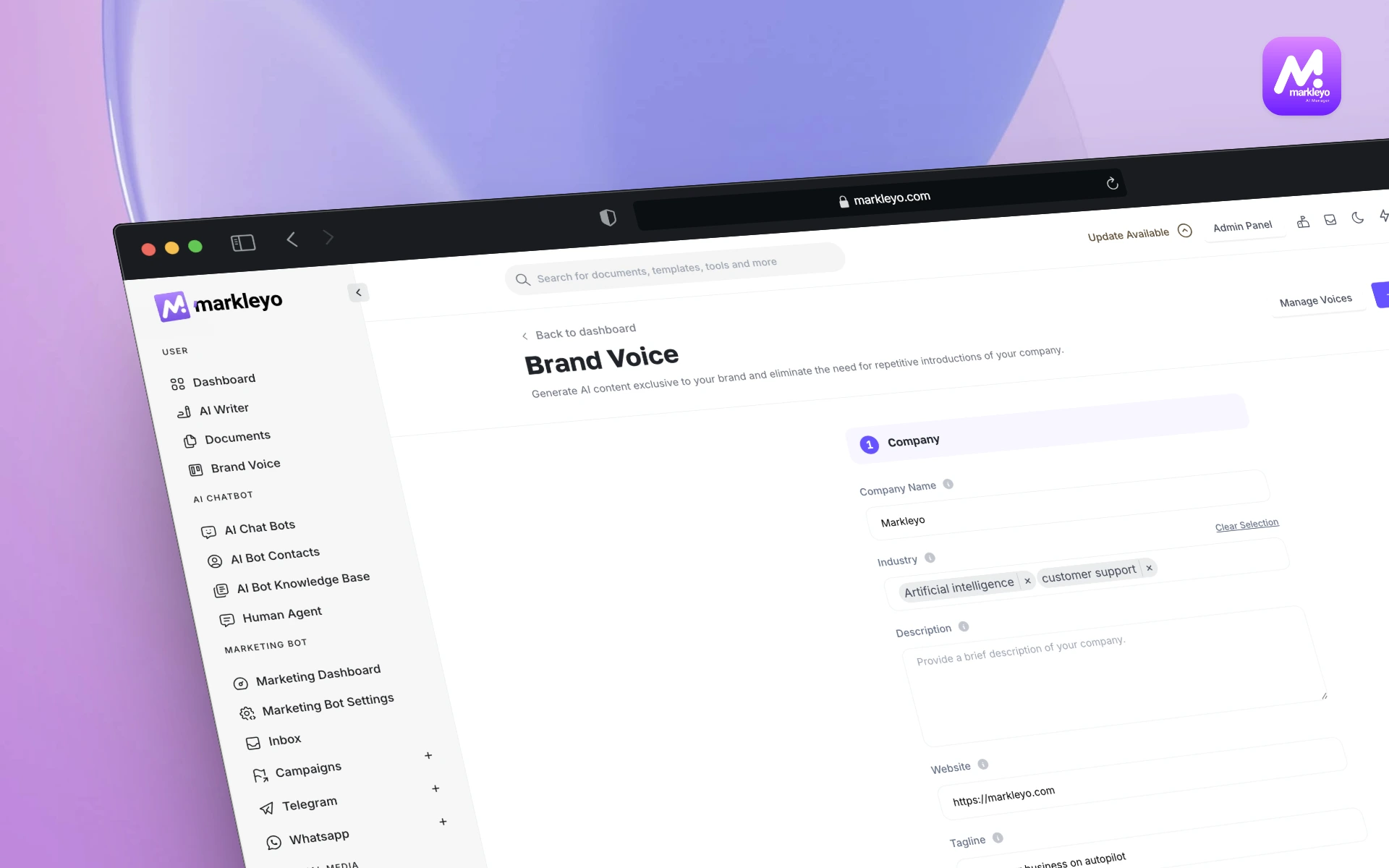
Markleyo allows businesses to upload voice profiles including tone, vocabulary, and writing samples. The AI then learns your brand’s communication rhythm and applies it automatically across blog posts, emails, and product copy.
When the marketing team at “Glow Skincare” used Markleyo, they reduced their editing time by 65% while maintaining a consistent, soft, and nurturing brand voice across all campaigns.
This demonstrates how structured voice training can transform AI into a true creative partner, one that strengthens rather than replaces human storytelling.
Conclusion
Training AI to match your brand voice and style is not about making machines sound human, it’s about making them sound like you.
By defining your brand personality, building a comprehensive style guide, and fine-tuning prompts, you create a digital writing assistant that truly understands your tone.
Consistency is what builds trust, and trust is what builds brands. With AI, you can scale content production without sacrificing authenticity giving your brand a unified, powerful voice across every platform.
FAQs About Train AI to Match Your Brand Voice
Why should I train AI to match my brand voice?
Because when you train AI to match your brand voice, it ensures consistency, saves editing time, and strengthens emotional connection with your audience.
How do I create a brand voice?
Document your tone, language preferences, personality traits, and real examples of approved writing.
Can AI adapt to multiple brand tones?
Yes. With separate profiles, AI can switch between tones for different audiences or campaigns.
How often should I update my voice training?
Every 3–6 months, or when your brand messaging evolves.