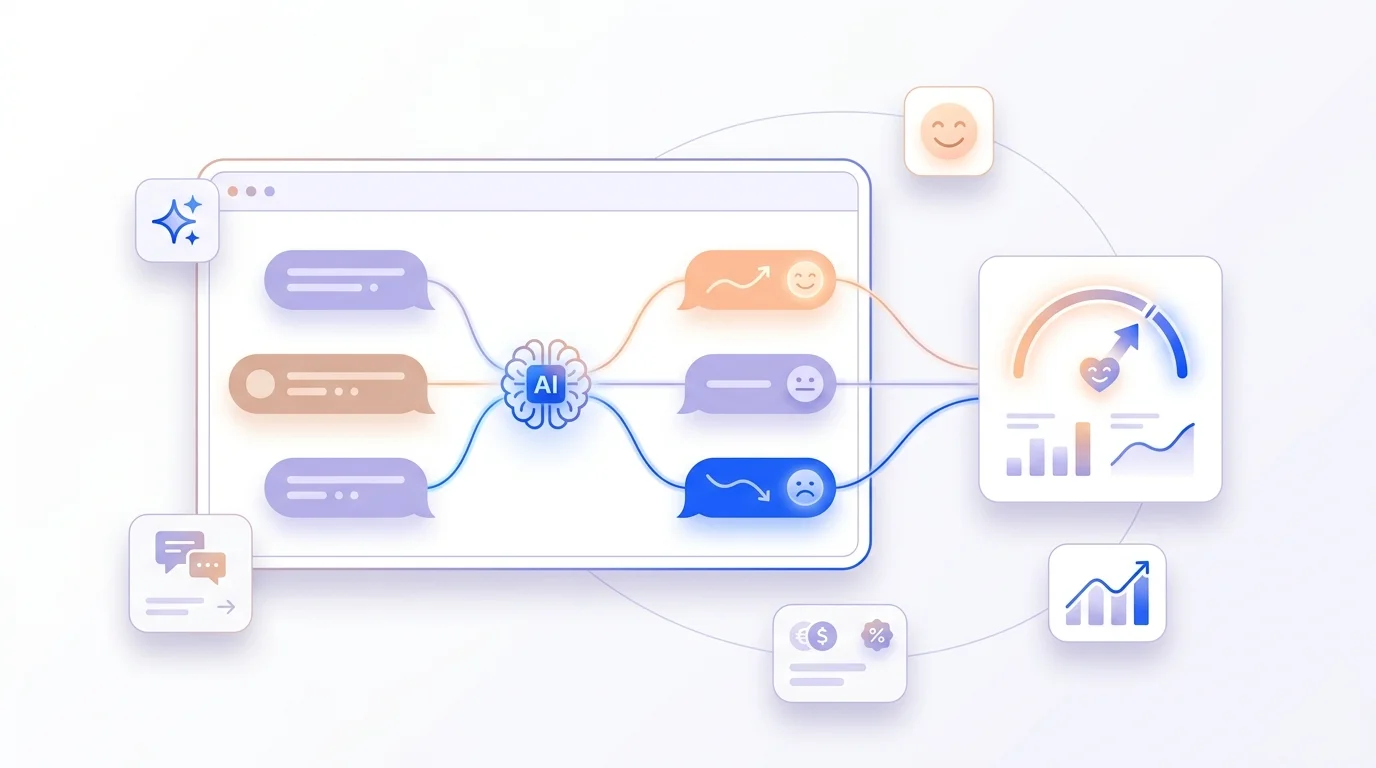
How Sentiment Analysis Improves Customer Experience (With Real Tools and Costs)
Sentiment analysis is software that reads what customers write (reviews, chats, emails, social posts) and labels each message as positive, negative or neutral, so you can spot unhappy customers fast and fix problems before they spread. The scoring itself is nearly free, about $1 per million characters on AWS, Google or Azure. The real cost is collecting the messages, which is why social listening tools start around $24 a month and big platforms cost $50,000+ a year.
That one fact changes how you should shop. Most small businesses do not need an expensive platform. They need a way to gather feedback in one place and a cheap, honest scorer on top.
This guide explains what sentiment analysis is, how the technology works in plain words, the real tools and prices in 2026, and a step-by-step way to run customer sentiment analysis on your own feedback this week.
Table of Contents
What is sentiment analysis?
Sentiment analysis is a way for a computer to figure out the feeling behind words. You give it a sentence like “The delivery was late again,” and it tells you: negative.
Think of it like a very fast reader who sorts a pile of letters into three boxes: happy, unhappy and “just asking a question.” A person can sort 100 letters in an hour. Software can sort a million in minutes.
When businesses point this at their own reviews, support chats and social comments, it is called customer sentiment analysis. The goal is simple: find out how customers feel, at scale, without reading every message by hand.
Sentiment analysis vs semantic analysis
People mix these up. Here is the difference.
| Sentiment analysis | Semantic analysis | |
|---|---|---|
| Question it answers | How does the writer feel? | What is the writer talking about? |
| Example output | “Negative, strong” | “Topic: delivery, late order” |
| Best use | Spotting angry or happy customers | Grouping messages by topic |
| Used together? | Yes. The best tools do both, so you know who is upset and about what |
The five types of sentiment analysis
Not every tool does the same job. These are the five main types.
| Type | What it tells you | Example |
|---|---|---|
| Fine-grained | A score, not just positive or negative (like 1 to 5 stars) | “Very negative” vs “slightly negative” |
| Aspect-based | The feeling about each part of a product | “Love the food (+), hate the wait (−)” |
| Intent-based | What the customer wants to do next | “I want to cancel” or “I want to buy” |
| Emotion detection | The actual emotion | Anger, joy, frustration, fear |
| Multilingual | Feelings across many languages | Spanish, Arabic and English reviews in one report |
For improving customer experience, aspect-based is usually the most useful, because it points at exactly what to fix.
How does sentiment analysis actually work?
It happens in three simple steps.
Step 1: Clean the text
The software tidies up each message first. It splits sentences into words (called tokenization), turns words into their base form so “running” and “ran” both become “run” (called lemmatization), and removes filler words like “the” and “a” (called stop-word removal).
Step 2: Turn words into numbers
Computers do not understand words, only numbers. So each word or sentence becomes a list of numbers called an embedding. Words with similar meanings get similar numbers, so “awful” and “terrible” end up close together.
Step 3: Score the feeling
A model looks at those numbers and decides: positive, negative or neutral, often with a confidence score like “92% sure this is negative.”
NLP for sentiment analysis: the four sentiment analysis methods
NLP (natural language processing) is the branch of AI that teaches computers to read human language. There are four main sentiment analysis methods built on it.
| Method | How it works | Good at | Weak at | Cost to run |
|---|---|---|---|---|
| Rule-based | A word list: “great” = +1, “awful” = −1 | Fast, free, easy to explain | Sarcasm, context, new slang | Free (for example, VADER, which is open source) |
| Machine learning | A model learns from thousands of labelled examples | Your industry’s own language | Needs training data | Low to medium |
| Generative AI (LLMs) | A large language model reads the message like a person would, often with a few examples in the prompt (few-shot prompting) | Context, sarcasm, mixed feelings, explaining why | Slower, costs more per message | Medium |
| Hybrid | Rules plus machine learning or LLMs together | Best overall accuracy | More setup | Medium |
Most cloud services, like Amazon Comprehend, Google Cloud Natural Language and Azure AI Language, use machine learning models you can call with no training. Newer tools add LLMs on top to catch the tricky cases.
Where sentiment analysis still gets things wrong
Even good tools slip on three things:
- Sarcasm. “Yeah, great. It took three weeks to arrive.” Every word looks happy. The meaning is angry.
- Negation. “I wouldn’t say the subscription was expensive.” The word “expensive” is there, but the feeling is actually positive.
- Mixed feelings (multipolarity). “The staff were lovely but the room was dirty.” One score for the whole message hides both facts. Aspect-based tools handle this best.
Top tools usually land around 80–90% accuracy on clear English text, and lower on sarcasm, slang, emojis and messages that mix two languages. Do not trust any vendor’s accuracy number blindly. Test it on your own messages (Step 4 in the how-to below shows how).
How sentiment analysis improves customer experience
Here are five practical ways it helps real businesses.
- You catch angry customers before they leave. A negative score on a support chat or review can alert a person to step in the same day, not three weeks later when the customer has already cancelled.
- You find the real problem, not just the complaint. Aspect-based analysis shows that 60% of negative reviews mention “delivery,” for example. That tells you where to spend money first.
- You measure whether a fix worked. Change your return policy, then watch whether negative mentions of “returns” go down over the next month.
- You protect your brand on social media. A sudden jump in negative posts is often the first sign of a problem going viral. Social listening tools send an alert so you can respond within hours.
- You hear from the quiet majority. Surveys only reach people who fill them in. Sentiment analysis reads everything customers already wrote, including the ones who never answer surveys.
An honest note about chatbots: some chatbots, including Markleyo AI, can hand a conversation to a human when a customer asks for one. That is useful, and research from Drift found people rated human replies about four times better than bot-only replies. But a chatbot handover is not the same as a sentiment analysis platform. If you need scored reports and trend dashboards, you need one of the tools below. Markleyo is a conversational AI platform, not a sentiment analysis tool.
The cost truth: scoring is cheap, collecting is not
This is the most important table in this guide. Sentiment tools fall into two groups, and they are priced very differently.
| Text-scoring engines | Social listening suites | |
|---|---|---|
| What they do | Score text you already have | Find mentions across the web and social media, then score them |
| Examples | Amazon Comprehend, Google Cloud Natural Language, Azure AI Language, VADER | Awario, Brand24, Determ, Brandwatch, Meltwater |
| Typical price | About $1 per million characters (VADER is free) | About $24/month up to $50,000+/year |
| Who it suits | You already have reviews, surveys or chat logs in a spreadsheet | You need to know what people say about you on social media and the web |
| Skill needed | Some technical setup, or a spreadsheet add-on | None. Log in and read the dashboard |
A real example of the price gap: scoring one million tweets costs roughly $200 on AWS, but about $1,000 on Azure, because Azure charges per record while AWS charges per chunk of characters. Same job, five times the bill. Always check how a tool counts usage.
What are the top sentiment analysis software solutions for small businesses?
The top options for a small business are free tools for getting started (VADER, Hootsuite’s free analyzer, Google Alerts for mentions) and low-cost paid tools like Awario and Determ once you need monitoring every day. Only move to Brandwatch-level platforms when you have a large brand and a dedicated team.
Free sentiment analysis options
| Tool | What it does | Catch |
|---|---|---|
| VADER | Free open-source rule-based scorer, very good on short social posts | Needs a little Python or a spreadsheet add-on |
| Hootsuite free sentiment analyzer | Paste text, get a score | One piece of text at a time |
| Google Alerts | Emails you when your brand is mentioned on the web | No sentiment score, no social media |
| Cloud free tiers (AWS, Google, Azure) | Score thousands of messages free each month, then about $1 per million characters | Needs some technical setup |
Paid sentiment analysis tools (published 2026 prices)
| Tool | Starting price | Best for | Watch out for |
|---|---|---|---|
| Awario | About $24–29/month (billed yearly) | Lowest published price for social listening | Mention limits on the entry plan |
| Brand24 | Around $29–$199/month (prices changed in 2026) | Easy dashboards, good for small teams | Check the current plan page. Prices vary by source |
| Determ | $99/month | Teams, because every plan has unlimited seats | Fewer data sources than enterprise tools |
| Sprout Social | About $199 per seat/month | Businesses already managing social posts in one place | Cost grows with every user you add |
| Mention | Demo required (reported $41 solo to $599) | Media and PR monitoring | Pricing not fully public |
| Brandwatch | From about $800/month | Large brands, deep research | Overkill for most small businesses |
| Meltwater | $50,000+/year | PR and media teams at big companies | Annual contracts |
| Sprinklr | $60,000+/year | Enterprise customer experience teams | Long setup, big contracts |
Pricing warning: Brand24 and Mention prices were reported very differently by different sources in 2026. Always confirm on the vendor’s own pricing page before you budget.
Best sentiment analysis tools for social media monitoring
For social media monitoring, Awario is the cheapest serious option, Brand24 and Determ are the best value for small teams, Sprout Social suits businesses that also publish posts, and Brandwatch, Meltwater and Sprinklr are for big companies with big budgets.
| Budget | Best pick | Why |
|---|---|---|
| $0 | Google Alerts + Hootsuite free analyzer | Free mention alerts and spot checks |
| Under $50/month | Awario | Lowest published price with real sentiment scoring |
| $50–$200/month | Brand24 or Determ | Better dashboards. Determ includes unlimited users |
| $200–$1,000/month | Sprout Social or Brandwatch | Publishing and listening in one, or deep research |
| $50,000+/year | Meltwater or Sprinklr | Enterprise, many brands, many countries |
Hidden costs to ask about
- Mention limits. Cheap plans often cap how many posts they track. A viral day can use up a whole month.
- Seats. Sprout Social charges per user. Determ does not. For a team of five, that difference is large.
- Setup fees. Enterprise tools often charge $2,000–$10,000+ to implement.
- Data sources. Some tools can’t read Instagram or TikTok comments fully because of platform limits. Ask which sources are included.
- Trials. Insist on a 14-day trial with all features, and test it on your own brand, not a demo account.
How to perform sentiment analysis on customer feedback
Here is a simple eight-step process any small business can follow.
- Pick one goal. For example: “Find the top three reasons customers leave bad reviews.”
- Collect your feedback in one place. Export reviews, survey answers, support chats and emails into one spreadsheet with a column for the text, the date and the source.
- Clean it up. Remove duplicates, spam and messages with no words (like a single emoji, unless you want to score those too).
- Label 50 messages by hand. Mark each one positive, negative or neutral yourself. This is your answer key for testing any tool.
- Run a tool on the same 50. Try VADER or a cloud free tier first. Compare its labels to yours. If it agrees on at least 8 out of 10, it is good enough to use. If not, try an LLM-based tool.
- Score everything. Run the tool on the full spreadsheet.
- Group by topic. Sort the negative messages into topics like delivery, price, staff or product quality. Aspect-based tools do this for you. A spreadsheet filter works too.
- Act and re-check. Fix the biggest problem first, then run the analysis again in 30 days to see whether negative mentions dropped.
Privacy note: customer messages can contain names, emails and order numbers. Remove personal details before sending text to any outside tool, and check that the tool’s data policy fits the privacy laws where you and your customers live.
How we compared these tools
We checked each vendor’s pricing page and documentation in August and September 2026, compared independent reviews where prices were hidden, and read Amazon Web Services’ sentiment analysis guide (updated 11 September 2026) for the technical background. Where sources disagreed, we say so instead of picking one number. We have no paid relationship with any tool listed. Markleyo is our own product, and we have said clearly what it does not do.
Frequently asked questions
What is sentiment analysis in simple words?
It is software that reads customer messages and decides whether each one sounds happy, unhappy or neutral, so you can find problems quickly without reading everything yourself.
What are the main sentiment analysis methods?
There are four: rule-based (word lists), machine learning (models trained on examples), generative AI or large language models (which read context like a person), and hybrid (a mix). Hybrid and LLM methods handle sarcasm and mixed feelings best.
What is NLP for sentiment analysis?
NLP, or natural language processing, is the part of AI that helps computers understand human language. Sentiment analysis is one job NLP does: it cleans text, turns words into numbers and then scores the feeling.
How much does sentiment analysis cost?
Scoring text you already have costs about $1 per million characters on AWS, Google or Azure, and free tools like VADER cost nothing. Social listening tools that also find mentions for you cost from about $24 a month (Awario) to $50,000+ a year (Meltwater, Sprinklr).
What is the best customer sentiment analysis tool for a small business?
Start free with VADER or a cloud free tier for reviews and surveys. If you need social media monitoring, Awario is the cheapest serious option, and Determ is good value for teams because every plan includes unlimited users.
How accurate is sentiment analysis?
Good tools are usually 80–90% accurate on clear English text and less accurate on sarcasm, slang, emojis and mixed languages. Test any tool on 50 of your own hand-labelled messages before trusting it.
Can a chatbot do sentiment analysis?
Some chatbots can pass a conversation to a human when a customer asks, and some claim to detect frustration. That is helpful but it is not full sentiment analysis with reports and trends. Ask any chatbot vendor to show you exactly what it detects and where the data goes.
Is sentiment analysis the same as social listening?
No. Sentiment analysis scores the feeling in text. Social listening finds mentions of your brand across the web and social media. Most listening tools include sentiment analysis, but a sentiment scorer alone does not go looking for mentions.
The bottom line
Sentiment analysis improves customer experience by showing you who is unhappy and why, early enough to fix it. You do not need to spend much to start: the scoring is almost free, and a spreadsheet plus a free tool will teach you more in a week than a year of guessing. Pay for a social listening suite only when you need to track what the whole internet says about you, and always test accuracy on your own messages first.
Want customers to reach a real person the moment they need one? Markleyo AI answers questions on your website, WhatsApp, Telegram, Instagram and Messenger around the clock and hands conversations to your team when a customer asks. Start a free Markleyo AI trial from $14.50/month. (Markleyo is a conversational AI platform, not a sentiment analysis or social listening tool.)