9 Best Intercom Alternatives in 2026 (After the Salesforce Deal)
The best Intercom alternatives in 2026 are Markleyo AI, Tidio, Crisp, Help Scout, Freshdesk, Zendesk, Gorgias, Chatbase, and Chatwoot. Two big things changed this year: Intercom renamed itself Fin, and Salesforce agreed to buy it for about $3.6 billion. On top of that, its AI charges $0.99 every time it works. This guide compares all nine on real published prices, and tells you honestly which one fits your team.
Quick answer: which Intercom alternative should you pick?
If you read one section, read this one.
| You are… | Best pick | Why |
|---|---|---|
| A small business that wants chat, calls, social, and content in one bill | Markleyo AI | Flat price, six AI tools, no per-answer meter |
| A small online store with a few hundred chats | Tidio | Cheap widget, real free plan, easy Shopify setup |
| A small team that mostly needs a shared inbox | Crisp | Flat price with seats included |
| An email-first support team that needs a help centre | Help Scout | Free knowledge base, free for 5 users |
| A team that wants a full help desk without enterprise prices | Freshdesk | Free for 2 agents, cheapest real ticketing |
| A large company with compliance rules | Zendesk | Deepest platform, most integrations |
| A Shopify or ecommerce brand | Gorgias | Built around orders, returns, and refunds |
| A solo founder who just needs one FAQ bot | Chatbase | Fastest way to launch a single bot |
| A technical team that wants to pay nothing | Chatwoot | Free and open source if you self-host |
What happened to Intercom, and why are people leaving?
Something unusual happened in 2026. The company you were comparing against does not really exist under that name anymore.
Intercom is now called Fin
In May 2026, Intercom changed its own name. CEO Eoghan McCabe announced the company was changing its name to Fin — the name of its AI agent — signalling a complete pivot around its AI agent business. For nearly 15 years, Intercom had been known as a primarily human-centred help desk product.
So when you read “Intercom” and “Fin” in comparison articles, they are the same company. The classic help desk product was kept and upgraded under the name “Intercom 2”.
Why does this matter to you? Because it tells you where the company is heading. It renamed itself after its support robot. If you were using Intercom for marketing, lead capture, or customer engagement, you are no longer the customer it is building for.
Salesforce is buying it for $3.6 billion
On June 15, 2026, Salesforce signed a definitive agreement to acquire Fin for approximately $3.6 billion. It is a signed agreement, not a completed acquisition. Salesforce expects the deal to close in the fourth fiscal quarter of 2027, subject to regulatory approval. The product is set to fold into Salesforce’s Agentforce platform.
Let’s be fair here, because a lot of articles are being dramatic about this. Until the deal closes, Salesforce does not own Fin, and Fin continues to operate as its own product. In the near term, very little changes — your instance, contract, and support continue as they are.
But there is a real worry underneath. One analysis describes the usual pattern: a category-defining independent tool gets acquired, the roadmap reorients around the acquirer’s data model and largest accounts, and pricing and packaging drift toward enterprise CRM contracts. For the biggest Salesforce shops that is often fine. For everyone in the mid-market, it is the start of a migration clock.
Think of it like your favourite local bakery being bought by a giant supermarket chain. The bread is the same today. But in two years, will it still be baked for you, or for their biggest wholesale buyer?
The five reasons teams look for an Intercom alternative
- The AI bill grows when the AI works. Fin charges per successful outcome. Better AI means a bigger invoice.
- You pay twice — for people and for answers. Seats are one bill. AI outcomes are a second, separate bill.
- There is no free plan. Only a trial.
- It is built for support, not marketing. Fin deflects tickets. It does not run your social media, call your leads, or write your blog posts.
- Acquisition uncertainty. Nobody knows what pricing looks like after the deal closes.
Point 4 deserves more attention than it usually gets. Fin is very good at answering “where is my order?” It is not built to turn a curious website visitor into a paying customer. If your chat window is supposed to do anything more than reduce support tickets, that is a real gap.
What does Intercom actually cost in 2026?
Here is the maths with real published numbers, not marketing talk.
Intercom has two separate bills stacked on top of each other:
- Seats. Essential is $29, Advanced is $85, and Expert is $132 per seat per month on annual billing. Monthly billing is higher.
- AI outcomes. Fin charges $0.99 per outcome, with a 50-outcome monthly minimum and no volume discount.
Now the part that catches people out. An “outcome” is not just a happy customer. Per Intercom’s pricing page, an outcome counts when the customer confirms resolution, when the customer does not ask for more help, or when Fin completes a workflow or Procedure — including handoffs to a human. It is charged at most once per conversation.
Read that again: you can be billed when the AI gives up and passes the customer to a real person. And you can be billed when someone simply closes the tab and walks away.
| Your team | AI outcomes / month | Intercom cost | Markleyo Complete |
|---|---|---|---|
| 2 seats (Essential) | 200 | $256/mo | $44/mo |
| 3 seats (Advanced) | 500 | $750/mo | $44/mo |
| 5 seats (Advanced) | 1,000 | $1,415/mo | $44/mo |
| 10 seats (Advanced) | 2,000 | $2,830/mo | $44/mo |
Seat prices are annual-billing rates. Outcomes at $0.99 each. Add-ons like Copilot (about $29 per agent per month) are extra.
That last row is not a made-up scare number. A third-party estimate puts 10 agents plus 2,000 monthly outcomes at roughly $2,830 a month. Another analysis reached about $3,100 a month for a 10-person team on the middle plan with a moderate AI workload — roughly four times the number on the pricing page.
Two more things worth knowing before you decide, because they cut both ways:
- “Lite seats” are not real seats. Advanced includes 20 and Expert includes 50, but they are limited-access seats for occasional collaborators, not agent licences — so do not plan headcount around them.
- Intercom runs an Early Stage programme offering up to 93% off year one for eligible startups (under $10M raised, under 15 employees). If that is you, Intercom may genuinely be your cheapest option in year one. Just model year two.
The 9 best Intercom alternatives in 2026
Each tool below is judged the same way: what it really costs at real volume, what you get included, which channels it covers, and who it honestly suits. All prices are published annual rates checked in July and August 2026.
1. Markleyo AI — best all-in-one alternative for small and growing businesses
Price: From $44/month flat on annual billing (Markleyo Complete) · 5-day free trial
Best for: Small businesses that want chat, phone calls, social media, and content in one subscription
Watch out for: It is not a help desk — no ticket queues, no SLA reporting, and a newer brand than the others here
Markleyo AI attacks the problem from a different direction. Instead of being a cheaper support tool, it replaces the stack of separate tools a small business normally pays for.
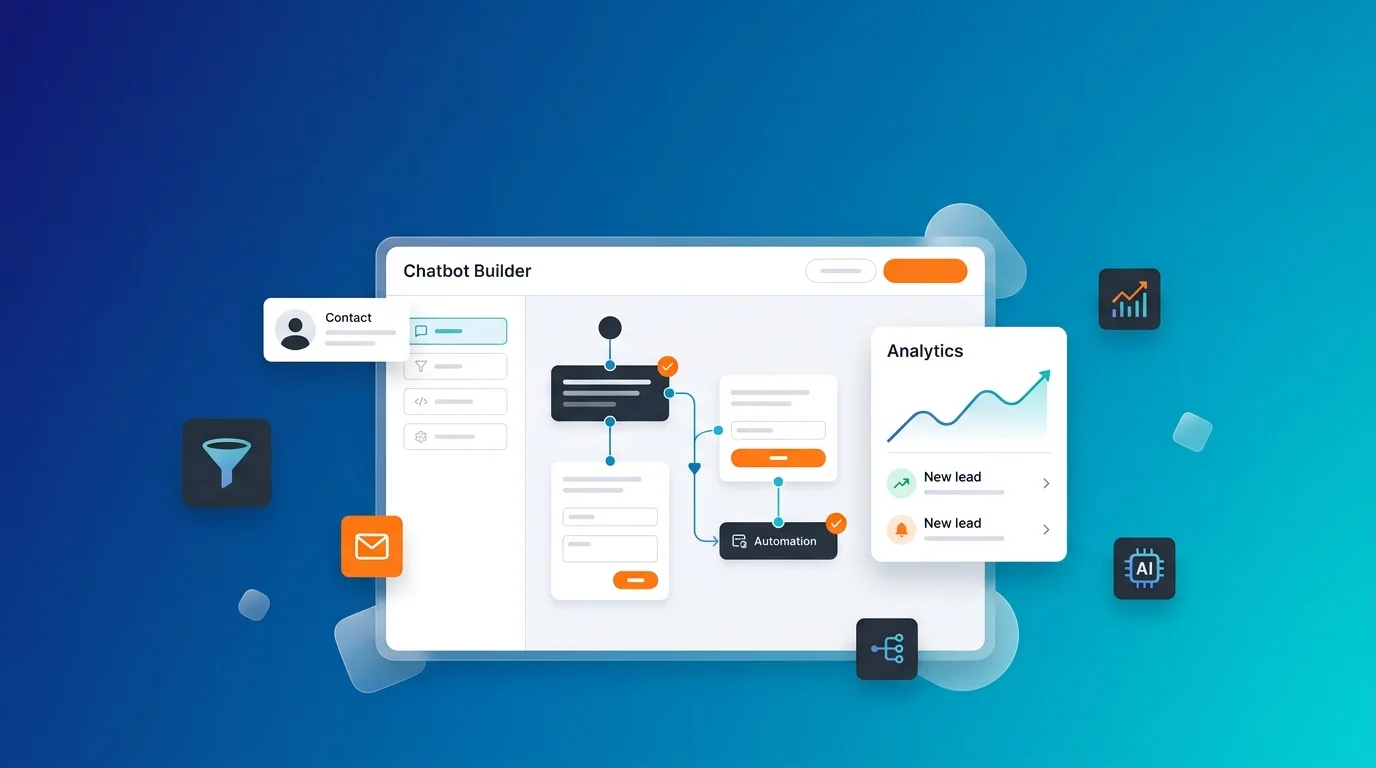
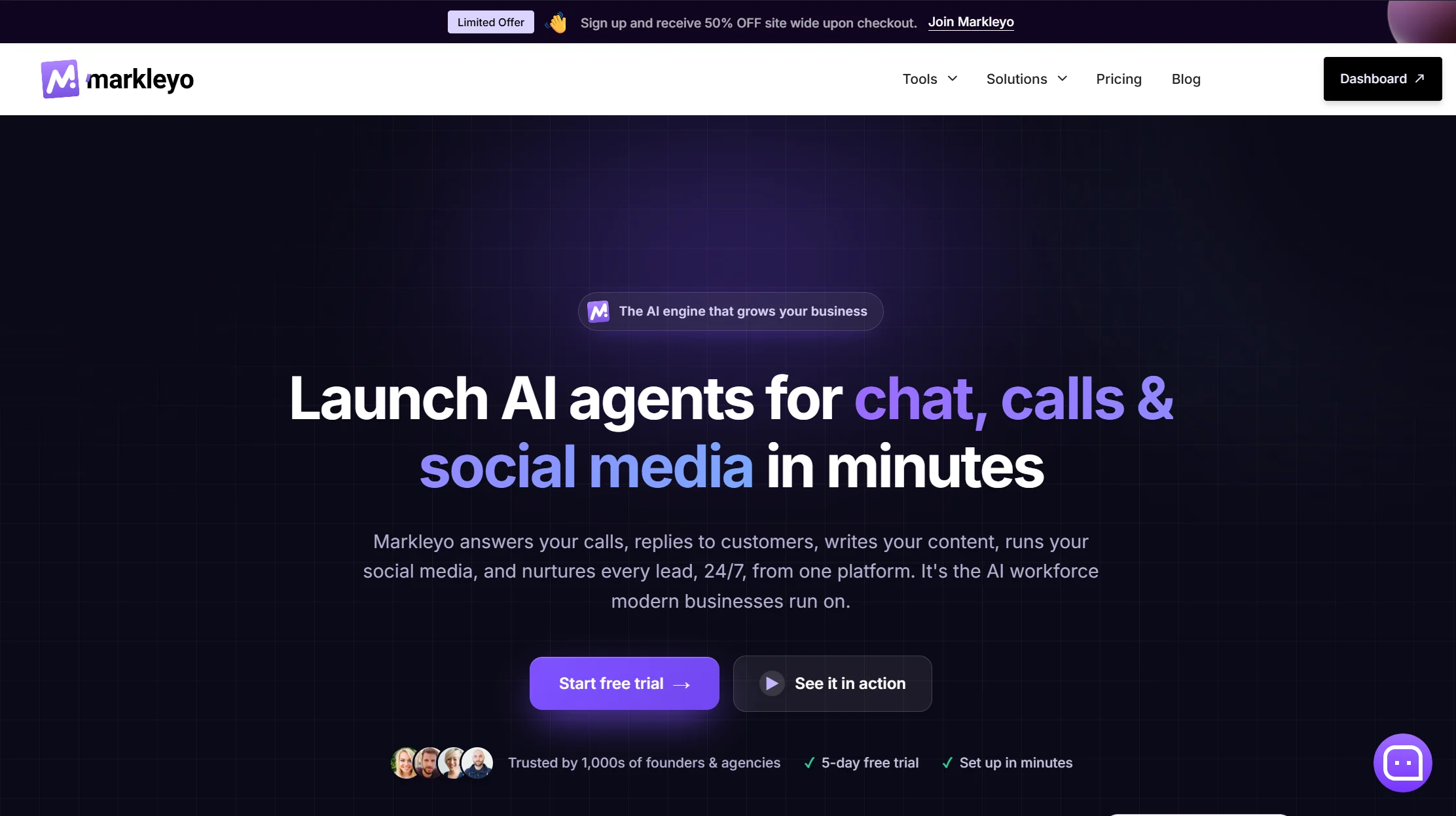
You get six AI workers in one plan. A CX chatbot agent answers questions on your website, WhatsApp, and Telegram. An AI calling agent picks up real phone calls in a human-sounding voice and books appointments. A social media suite writes and schedules posts. A marketing bot runs WhatsApp and Telegram broadcast campaigns. An AI copywriter writes SEO blogs and emails. A no-code agent builder links them into workflows. They all share one knowledge base, so you teach your business once and every agent knows it.
The pricing is the headline. One flat monthly price. No per-seat multiplier. No per-outcome meter. Look back at the cost table: a five-person team with 1,000 AI outcomes lands near $1,415 a month on Intercom. Markleyo Complete starts at $44. Even ignoring the calling agent, the social suite, and the copywriter, the chatbot alone changes your budget category.
It also covers the gap Fin leaves open. Fin reduces support tickets. Markleyo is built to capture leads, run campaigns, and follow up — the customer engagement work Intercom used to be famous for before it renamed itself after a support bot.
Honest trade-off, and this one matters. Markleyo is not a ticketing system. If you need agent queues, SLA timers, CSAT dashboards, and audit logs for a 40-person support floor, pick Zendesk or Freshdesk instead — genuinely. Markleyo suits founders, agencies, service businesses, and small teams who want conversations handled and leads captured, without six subscriptions.
See the full feature list on the Markleyo AI chatbot page or the pricing page.
2. Tidio — best cheap live chat for small online stores
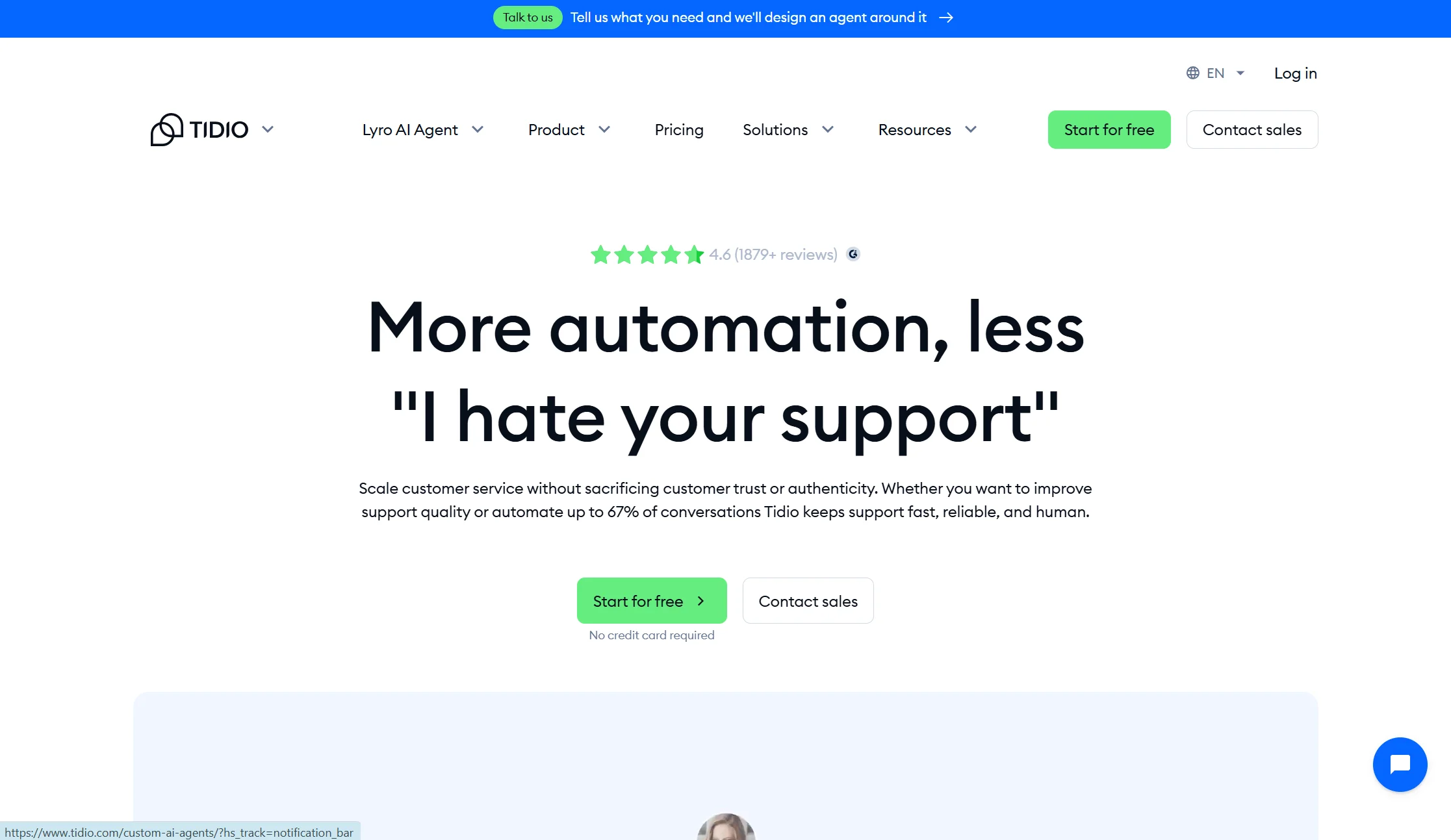
Price: Free plan with 50 handled conversations a month; Starter around $24/mo annual; Growth from around $49/mo annual for up to 2,000 conversations; Lyro AI add-on from about $32/mo annual for 50 AI conversations, rising to roughly $140/mo for 1,000
Best for: Shopify and WooCommerce stores with a few hundred chats a month
Watch out for: Two meters running at once, and a steep jump at the top
Tidio is the friendliest place to start. There is a real free plan, setup takes minutes, and the widget looks good with no design work. Its AI agent, Lyro, learns from your help centre and FAQs.
The catch matters. Tidio’s base plan is priced by conversations handled, and Lyro AI conversations are a separate add-on — so the AI can quietly double your bill. There is also a sharp jump from Growth to the Plus plan, which starts at around $300 plus usage once you pass 2,000 conversations.
Verdict: much cheaper than Intercom at low volume and a genuinely pleasant product. But it uses the same two-bill shape, so the squeeze returns as you grow.
3. Crisp — best flat-priced shared inbox
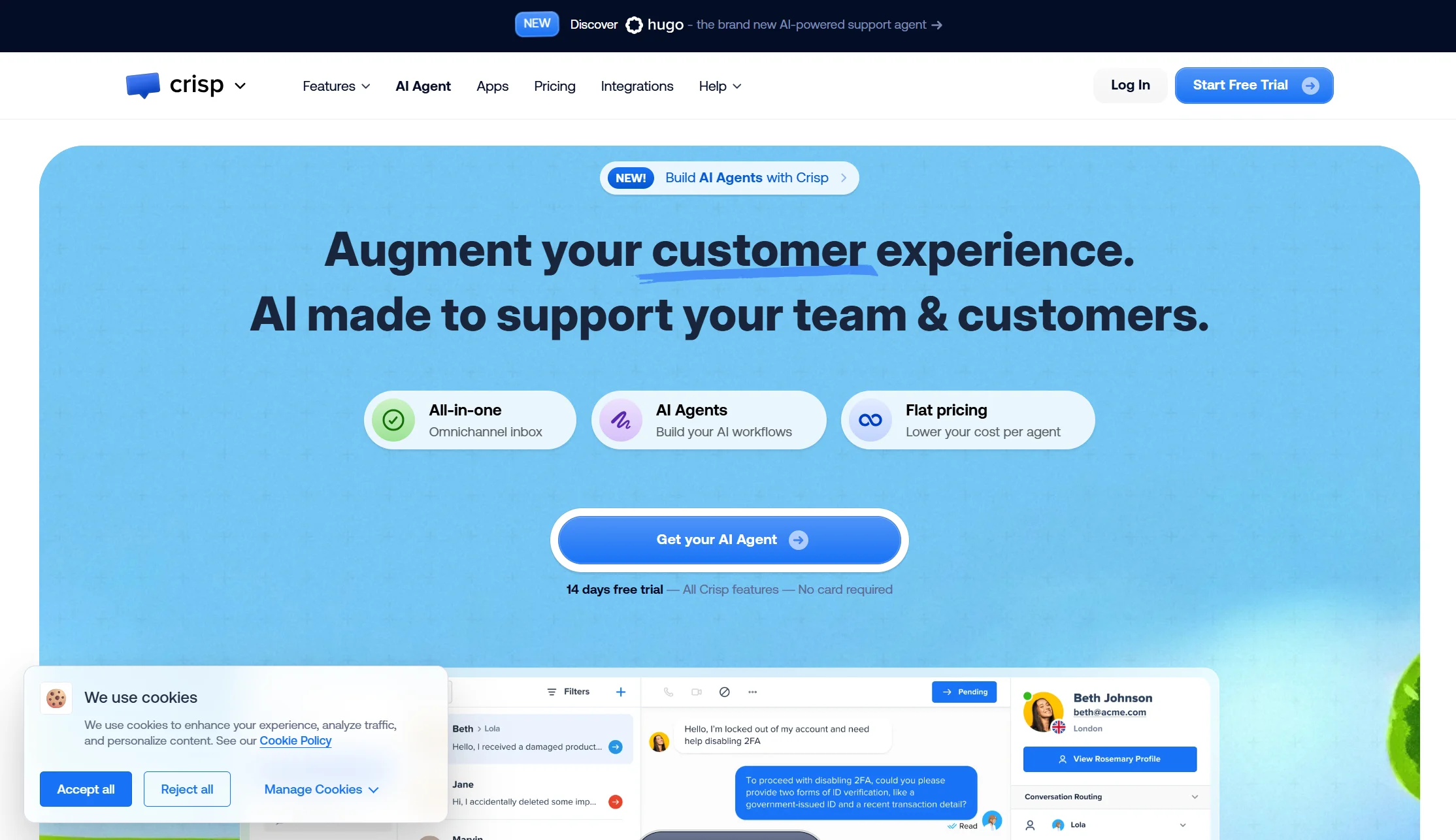
Price: Free plan with 2 seats; Mini $45/mo (4 seats); Essentials $95/mo (10 seats); Plus $295/mo (20 seats); $10 per extra agent
Best for: Small teams where humans do most of the answering
Watch out for: The included AI allowance is thin for the price
Crisp is one of the few tools here with genuinely flat pricing and seats included. Four seats for $45 a month is cheaper than one Intercom Advanced seat plus 50 AI outcomes.
If your priority is a good shared inbox rather than heavy automation, Crisp is excellent value. The limitation is the AI: the included allowance is small relative to plan price if automation is your main goal.
Verdict: the best answer to “I want affordable live chat for my human team.” A weaker answer to “I want a bot that closes most conversations alone.”
4. Help Scout — best for email-first teams who need a knowledge base
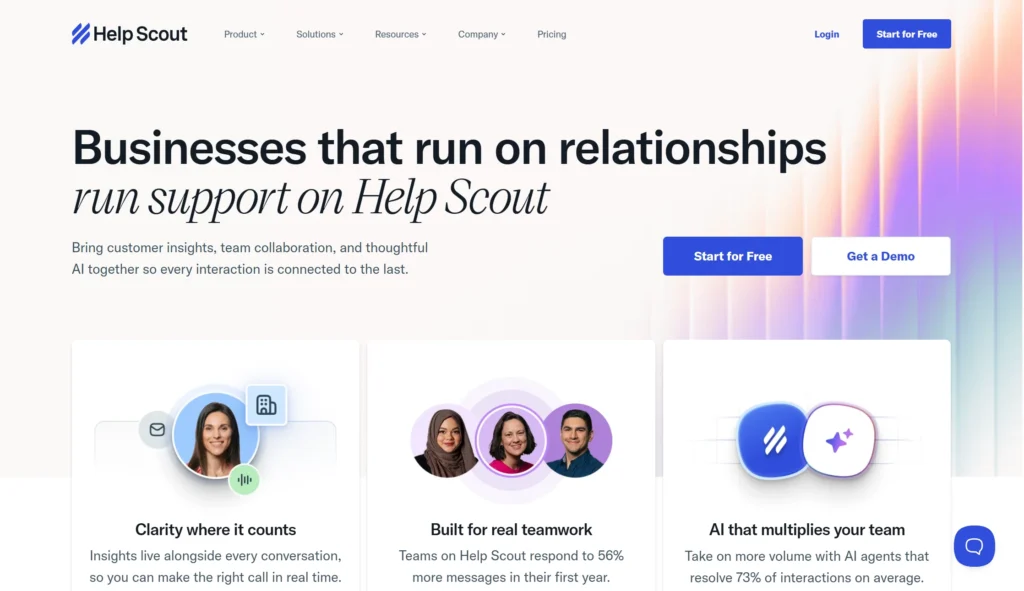
Price: Free plan for 5 users with 1 Inbox and 1 Docs site; Standard $25/user/mo; Plus $45; Pro $75; AI Answers at $0.75 per resolution
Best for: Support teams whose main channel is email, not live chat
Watch out for: Seats and AI both grow with volume
Help Scout answers a question Intercom does not really answer: what if customers would rather help themselves? Its Docs product is a proper self-service knowledge base, free on the starter plan, and its AI pulls answers from it.
The shape is still familiar. Both seats and AI resolutions scale with volume, so the bill grows on two axes, and autonomous resolution runs on the Beacon widget rather than every channel. But at $0.75 per resolution it undercuts Fin’s $0.99, and the free tier for five users is generous.
Verdict: the strongest knowledge-base-first pick here, and a natural fit for teams migrating off Intercom’s help centre.
5. Freshdesk — best value full help desk
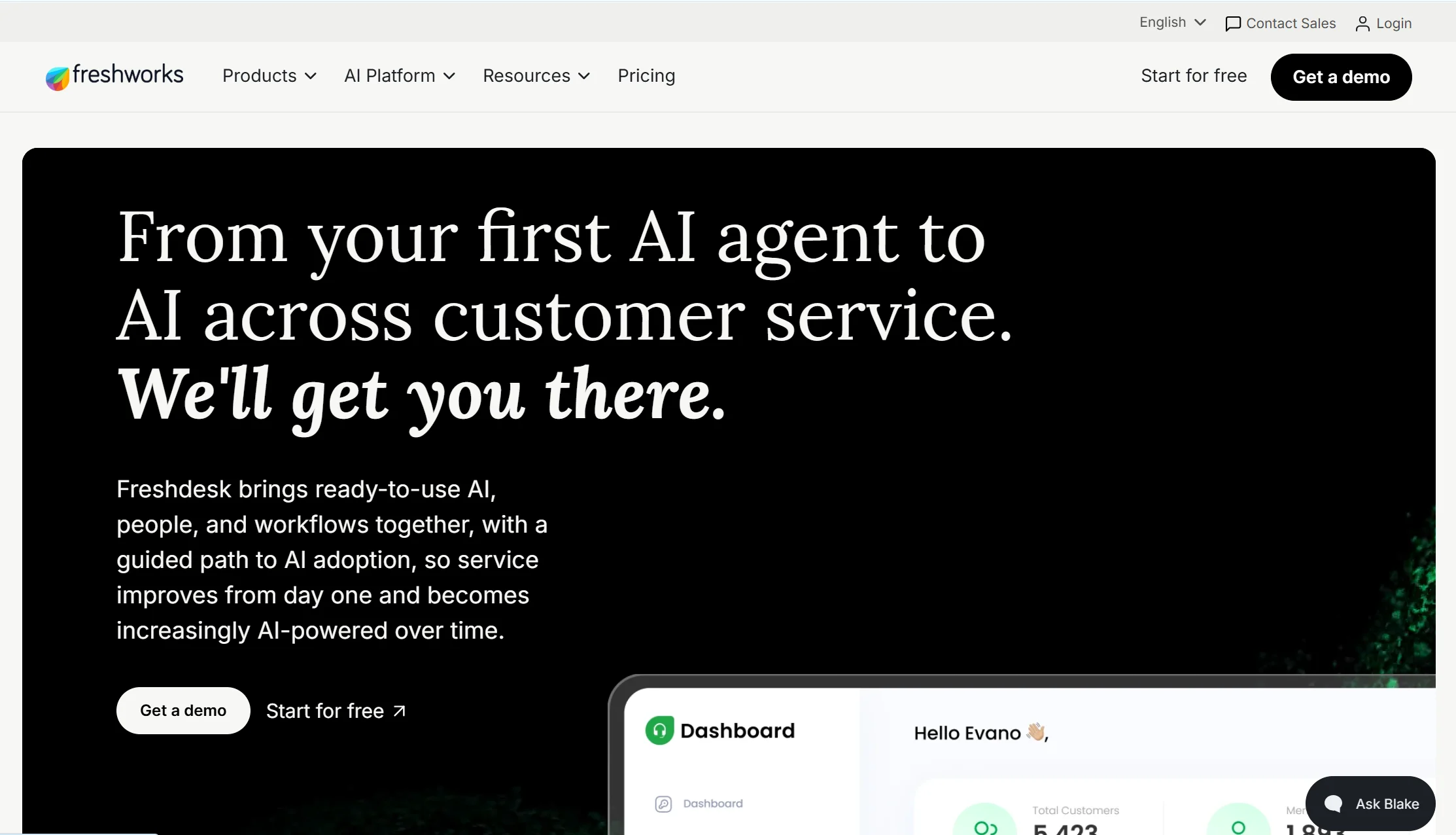
Price: Free plan for up to 2 agents; paid plans from about $15–19/agent/mo on annual billing up to $79/agent/mo Enterprise; Freddy AI Copilot adds about $29/agent/mo · Freddy AI Agent is billed per session at about $0.10, or $100 per 1,000 sessions
Best for: Teams that want real ticketing without enterprise prices
Watch out for: Per-session AI billing charges for every interaction, resolved or not
If you want what Intercom does — proper ticket management, automations, reporting — but without the bill, Freshdesk is the value pick. Its entry paid plan starts at $19 per agent per month on annual billing, and one analysis notes teams commonly spend 40–60% less than an equivalent Zendesk setup.
The AI pricing model is genuinely different, and it is a mixed blessing. Freddy AI Agent charges $0.10 per session, which looks inexpensive per unit — but the per-session model charges for every interaction regardless of resolution. At high deflection that is a bargain. At low deflection you pay for failures.
Verdict: the best straight swap for Intercom if you need a real help desk and want your money back.
6. Zendesk — best for large teams with compliance needs
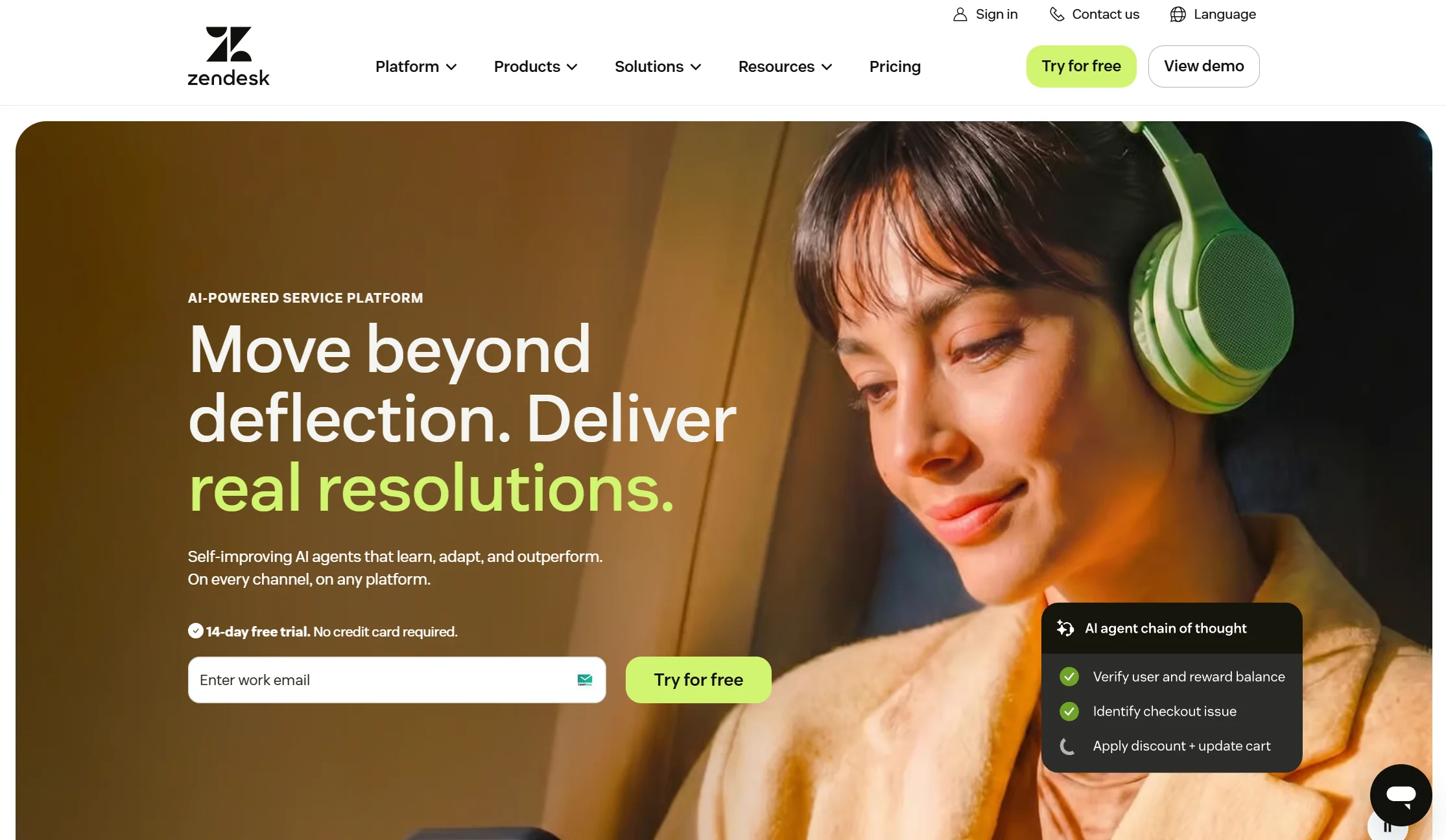
Price: Suite plans run $55 to about $169 per agent per month on annual billing. No free plan, only a 14-day trial. Copilot is $50/agent/mo, Quality Assurance about $35, and Workforce Management about $25 — stacking these onto Suite Professional reaches roughly $215 per agent per month
Best for: Enterprises that need depth, integrations, and audit trails
Watch out for: The AI meter is harsher than Intercom’s
Zendesk is the most complete platform on this list. If you have compliance requirements and a large support floor, it is a serious answer.
But do not switch here expecting to escape per-resolution billing — it is worse. Autonomous AI agents are included in every plan since May 2026, but only 5 to 15 automated resolutions per agent per month are free. Past that, resolutions are billed on top of seats, and the overage has been auto-charged and uncapped since January 2026. The rate is $1.50 per automated resolution on committed volume or $2.00 pay-as-you-go — and one breakdown puts a 20-agent team resolving 3,000 conversations a month at roughly $6,000–$8,000 a month all-in.
Verdict: more powerful than Intercom, and more expensive. Choose it for capability, never for cost.
7. Gorgias — best for Shopify and ecommerce brands
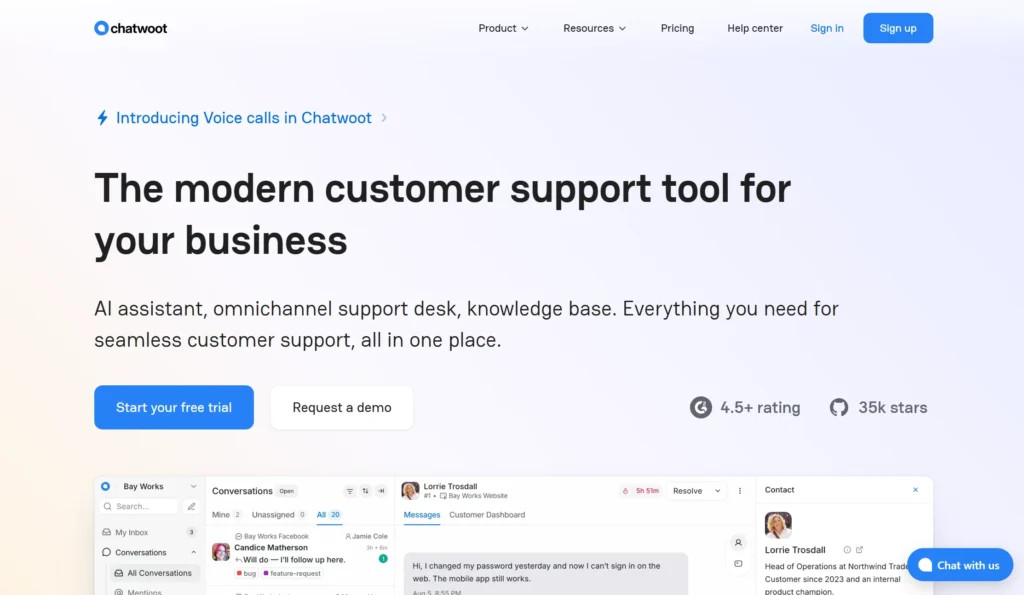
Price: Priced on ticket volume rather than per agent, with unlimited users on all plans · AI charges about $0.90–$1.00 per interaction
Best for: Online stores that live inside Shopify, BigCommerce, or WooCommerce
Watch out for: A real double-billing quirk
Gorgias is built around what stores actually deal with: orders, returns, refunds, and where-is-my-parcel. Unlimited users on all plans can be dramatically cheaper than per-agent pricing if you have a big team handling moderate ticket volume.
Now the quirk, and you should model it before signing. Each automated resolution consumes a helpdesk ticket from your plan quota as well as charging the AI fee, so an automated conversation can be billed twice — once for the ticket, once for the AI. At 1,000 monthly AI interactions that means roughly $1,260–$1,400 a month for the AI portion alone, plus your base plan.
Verdict: the best ecommerce fit by a distance, as long as you do the double-billing maths first.
8. Chatbase — best for a single FAQ bot on a tiny budget
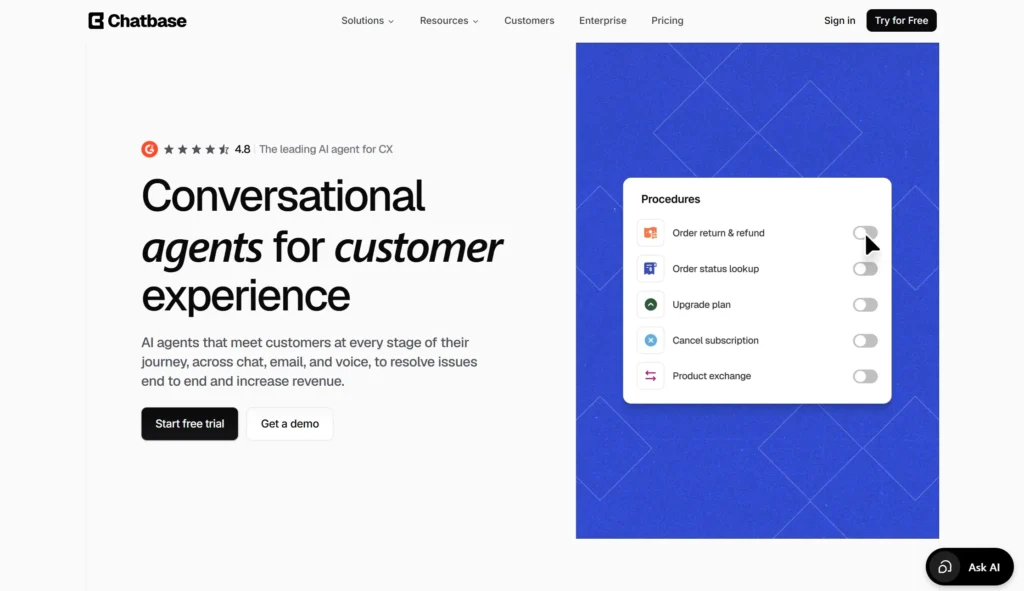
Price: Free plan with 50 credits/mo; Hobby $32/mo annual (500 credits, 2 seats); Standard $120/mo annual (4,000 credits, 3 seats); Pro $400/mo annual (15,000 credits, 5 seats)
Best for: Solo founders who need one bot trained on their documents
Watch out for: Credit maths, one-agent limits, and branding fees
Chatbase turns a pile of PDFs and help articles into a working bot fast. Upload, train, embed, done.
Then the small print. Each AI reply costs 1–6 credits depending on the model, so a top-end model burns six credits per reply versus one on a standard model. Every plan includes just one AI agent, and extra agents cost $300 a year. If credits run out the bot goes offline unless auto-recharge is on. Removing the “Powered by Chatbase” branding costs $1,188 a year.
Verdict: excellent for one simple bot. Not a support platform, and that branding fee alone costs more than a year of some all-in-one plans.
9. Chatwoot — best free and open-source Intercom alternative
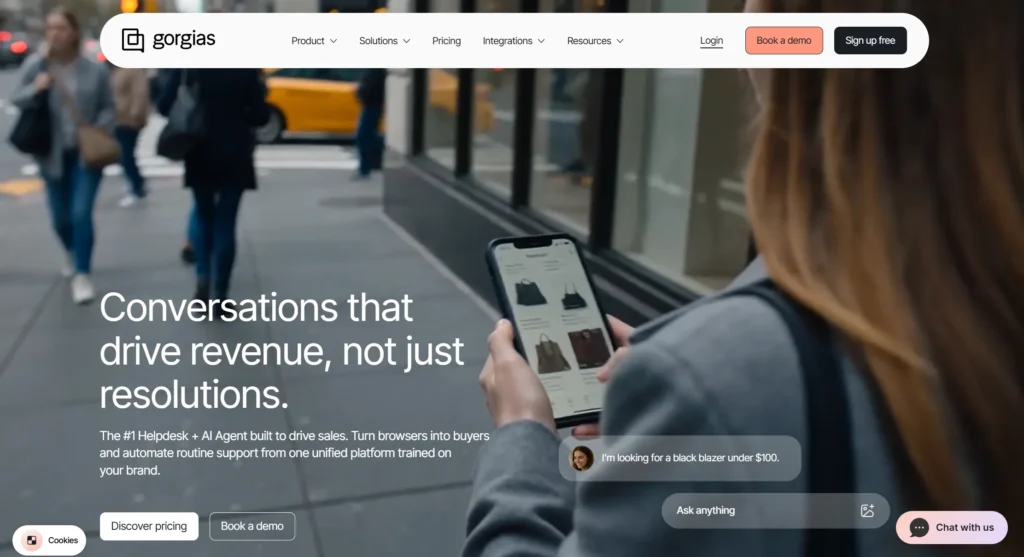
Price: Self-hosted Community Edition is free and open source. Cloud: Hacker free (2 agents, 500 conversations/month, live chat only, 30-day data retention); Startups $19/agent/mo; Business $39; Enterprise $99 — billed annually. Captain AI credits are included at 300, 500, and 800 per month respectively
Best for: Technical teams that want full data control and a bill of $0
Watch out for: Free means you become the IT department
Chatwoot is positioned as the open-source alternative to Zendesk and Intercom for teams that want self-hosting and no per-agent seat trap. If you have a developer and a server, the licence genuinely costs nothing.
Be realistic about what free costs you, though. Self-hosting can be free with the open-source version, but you handle all maintenance, updates, infrastructure, and external messaging costs yourself. The free cloud tier is bare-bones — basic live chat only, and it deletes all data after 30 days. Feature depth is also less than commercial platforms, and self-hosted deployment needs real technical expertise.
Verdict: the genuine zero-cost option, and a strong choice for agencies and regulated industries. Not a fit if nobody on your team enjoys server maintenance.
Full comparison table: all 9 Intercom alternatives side by side
| Platform | Starting price | How AI is billed | Free plan? | Best for |
|---|---|---|---|---|
| Intercom (Fin) | $29/seat/mo | $0.99 per outcome, 50/mo minimum | ❌ Trial only | Existing Intercom shops |
| Markleyo AI | $44/mo flat | Included in plan | ❌ 5-day trial | All-in-one for small business |
| Tidio | ~$24/mo | Separate Lyro add-on | ✅ 50 conv/mo | Small online stores |
| Crisp | $45/mo flat | Small included allowance | ✅ 2 seats | Human-led shared inbox |
| Help Scout | $25/user/mo | $0.75 per resolution | ✅ 5 users | Email + knowledge base |
| Freshdesk | ~$15–19/agent/mo | ~$0.10 per session | ✅ 2 agents | Best-value help desk |
| Zendesk | $55/agent/mo | $1.50–$2.00 per resolution | ❌ Trial only | Large teams, compliance |
| Gorgias | Ticket-volume based | ~$0.90–$1.00 per interaction | ❌ | Shopify and ecommerce |
| Chatbase | $32/mo | Credits (1–6 per reply) | ✅ 50 credits | One simple FAQ bot |
| Chatwoot | $0 self-hosted | Captain AI credits | ✅ Free tier | Technical teams, $0 budget |
Best Intercom alternatives by use case
The right answer changes depending on what you are actually trying to fix. Here is the shortlist for each situation.
What are the best Intercom alternatives for small businesses?
Small businesses have a different problem from enterprises. You are not comparing feature checklists — you are trying to avoid paying for six tools while doing the work of ten people.
For small businesses specifically, the order changes:
- Markleyo AI — one flat bill covering chat, calls, social posts, and content. No per-seat fee, so hiring your second and third employee does not raise your software cost.
- Freshdesk — free for two agents, and the cheapest route to real ticketing when you outgrow that.
- Tidio — best free tier to start with and the smoothest Shopify install.
- Crisp — best if three or four people all need inbox access.
Notice who is missing: Zendesk and Gorgias. Both are excellent, and both are built for bigger operations. Paying enterprise prices for enterprise features you will never open is the most common mistake small businesses make when they leave Intercom.
What are the top live chat software options for small businesses?
Live chat is the little message bubble in the corner of a website. Small businesses usually want three things from it: it should be cheap, it should install without a developer, and it should not go silent when everyone is asleep.
Ranked for exactly that:
- Markleyo AI — the widget answers in about eight seconds, then hands to a human. It also covers WhatsApp, Telegram, Instagram, and Messenger from the same inbox, plus phone calls. Best pick if you want one tool.
- Tidio — the easiest genuinely free starting point. One-click install on Shopify and WordPress.
- Crisp — best value once several people need to answer chats.
- Chatwoot — best if you want to own your data and pay nothing.
One question predicts your real cost better than any pricing page: if my chat volume triples, does my bill triple too? On per-outcome tools, yes. On flat plans, no. Ask it before you sign anything.
Which Intercom competitors are cheapest for AI automation?
If you want the robot to actually close conversations, compare the meters, not the sticker prices:
| Platform | AI cost per resolution |
|---|---|
| Freshdesk (Freddy Agent) | ~$0.10 per session |
| Help Scout AI Answers | $0.75 |
| Gorgias | ~$0.90–$1.00 (plus a ticket) |
| Intercom Fin | $0.99 |
| Zendesk | $1.50–$2.00 |
| Markleyo AI | Included in the flat plan |
A word of honesty: no chatbot resolves everything. Vendors typically report real resolution rates between about 50% and 65%. Zendesk markets 50 to 80 percent autonomous resolution, but the advertised rate and the real one diverge. Plan for a human handover from day one, and check that handover keeps the conversation history — losing it is the fastest way to annoy someone who was already stuck.
What is the best free alternative to Intercom?
Intercom has no permanent free plan, only a trial. Four alternatives do:
- Chatwoot Community Edition — free forever if you self-host. Most generous, most technical.
- Freshdesk — free for up to 2 agents with real ticketing.
- Help Scout — free for 5 users with 1 inbox and 1 knowledge base.
- Tidio — free for 50 handled conversations a month.
Every free tier here caps something low enough that a growing business outgrows it in weeks. Use them to test, not to build on.
Which Intercom alternative is best for ecommerce?
Gorgias, without much argument, if you are on Shopify and your tickets are mostly orders and returns. Tidio if you are smaller and want cheap chat with a Shopify plugin. Markleyo AI if your bigger problem is capturing leads and running WhatsApp campaigns rather than processing refunds.
Should you switch away from Intercom right now?
Honest answer: not automatically.
The Salesforce deal is signed, not closed. As of mid-2026 the product, support, and pricing are unchanged, and no customers are being migrated. One neutral guide puts it well: roadmap, pricing, and packaging can shift after an acquisition, but the product still works today — use the uncertainty as a prompt to plan, not a reason to panic-migrate.
Switch now if any of these are true:
- Your AI bill already exceeds your seat bill.
- You are being billed for handoffs and abandoned chats.
- You need marketing and engagement features Fin no longer prioritises.
- Your renewal lands after the deal is expected to close, and you would be locking in terms blind.
Stay for now if:
- You qualify for the Early Stage discount.
- Your volume genuinely sits near the 50-outcome minimum.
- Your team is deep in Intercom workflows and the switching cost outweighs the saving.
One practical tip: teams with renewals extending past the expected close date should read repricing and roadmap terms carefully. Do not sign a three-year deal in the middle of an acquisition.
How do you migrate from Intercom to another platform?
Moving sounds scarier than it is. This order causes the fewest problems.
Step 1 — Export your knowledge first. Pull your help articles, saved replies, and FAQs out before you cancel anything. That content is the asset you built. The tool is replaceable.
Step 2 — Understand what the easy export does not include. Transcripts do not come across in the simple CSV export, which is metadata only. They come from per-conversation text or PDF exports, the REST API, or a migration service. Custom attributes must be recreated as custom fields in the destination before import, or their values land nowhere.
Step 3 — Check your real numbers. Open your last three invoices and write down two figures: how many Fin outcomes you were billed for, and how many seats you paid for. Most teams discover they are on the wrong plan. These two numbers tell you which alternative wins for you.
Step 4 — Run both tools for two weeks. Put the new widget on one page or subdomain. Keep Intercom live everywhere else. Nobody should migrate blind.
Step 5 — Compare on one metric. Not “which feels nicer.” Use resolution rate: out of 100 conversations, how many ended without a human? Then work out cost per resolved conversation.
Step 6 — Move channels one at a time. Website first, then email, then WhatsApp. If something breaks you will know exactly what broke.
Step 7 — Cancel on your renewal date. Annual plans rarely refund. Time the switch, do not rush it.
Most teams finish in about two weeks of calendar time and a day of actual work.
How we picked and compared these 9 Intercom alternatives
Five tests, in this order:
- Real cost at real volume. Not the headline price — the price at 500 and 2,000 AI conversations a month.
- What is included. Seats, AI answers, chatbots, and channels before any add-on.
- Channel coverage. Website, email, WhatsApp, Telegram, Instagram, Messenger, phone.
- Human handover. Can a person take over cleanly, with history intact?
- Setup effort. Can a non-technical person launch it the same week?
Every price was checked against the vendor’s official pricing page or a dated third-party pricing tracker in July and August 2026. Prices move often — Intercom rebranded in May 2026 and Zendesk restructured its AI packaging the same month — so confirm before you buy.
We also excluded tools we could not verify pricing for. A vendor that hides its price behind a sales call cannot be compared fairly, and “contact us” is not a number.
Frequently asked questions About Intercom Alternative
Is Intercom the same as Fin?
Yes. In May 2026 the company formerly called Intercom renamed itself Fin, after its AI agent. “Fin” and “Intercom” refer to the same company. The traditional help desk product continues under the name “Intercom 2”. Most comparison articles still use “Intercom” because that is what people search for.
What is the cheapest Intercom alternative?
It depends on your volume, which is why sticker prices mislead. At zero budget, Chatwoot’s self-hosted Community Edition is free. For a small team wanting real ticketing, Freshdesk is free for two agents. At normal business volume — say 500 or more AI conversations a month — flat-priced plans win by a wide margin, because per-outcome tools keep charging while flat plans do not. Markleyo Complete at $44/month flat covers volume that costs around $750/month on Intercom with three seats.
Does Intercom really charge for handing a chat to a human?
Per Intercom’s pricing page, an outcome is billed when the customer confirms resolution, when the customer does not ask for more help, or when Fin completes a workflow or Procedure — including handoffs to a human. It is charged at most once per conversation. So yes, a handoff can count as a billable outcome, though you are only charged once per conversation rather than per message.
Which Intercom alternative supports WhatsApp and Telegram?
Markleyo AI covers website chat, WhatsApp Business, Telegram, Instagram, and Messenger, and adds broadcast campaigns on WhatsApp and Telegram. Tidio, Crisp, and Chatwoot cover WhatsApp and Messenger. Intercom supports WhatsApp but bills it as usage on top of your plan. Telegram support is rarer than you would expect — if your market is South Asia, the Middle East, or Eastern Europe, check this before shortlisting.
Can I replace Intercom and my marketing tools with one platform?
That is the specific case for Markleyo AI. Intercom handles support conversations but does not make outbound phone calls, schedule social posts, or write blog content. If you currently pay for a chat tool, a social scheduler, and an AI writer separately, an all-in-one platform collapses three bills into one — and, more usefully, lets those tools share one knowledge base instead of three disconnected ones.
Is Intercom still worth using in 2026?
For some teams, yes. If your AI volume sits near the 50-outcome minimum, you qualify for the Early Stage discount, or your workflows are deeply built into Intercom, it remains a well-engineered product with strong enterprise credentials. The case for leaving strengthens as your volume grows, your team grows, or your needs move from deflecting tickets toward generating and nurturing leads.
Will the Salesforce acquisition change Intercom’s pricing?
Nobody knows yet, and any article claiming certainty is guessing. As of mid-2026 the deal is signed but not closed, and pricing has not changed as a result. Salesforce expects to close in Q4 of its fiscal 2027, subject to regulatory approval. The reasonable position is to avoid long contracts until the picture is clear.
The bottom line: which Intercom alternative is right for you?
Intercom is not a bad product. It is a well-built platform with a pricing model that charges you more every time it succeeds, attached to a company that just renamed itself and agreed to be acquired.
Pick by the problem you actually have:
- Bill growing faster than your business? → Flat pricing. Markleyo AI or Crisp.
- Need more than support — leads, calls, campaigns, content? → Markleyo AI.
- Need real ticketing on a budget? → Freshdesk.
- Need enterprise depth and compliance? → Zendesk.
- Selling on Shopify? → Gorgias.
- Customers prefer self-service? → Help Scout.
- Just need one FAQ bot? → Chatbase.
- Have a developer and want to pay nothing? → Chatwoot.
Before you commit to any of them, do the one calculation almost nobody does. Take your actual outcome count from last month, multiply it out on each vendor’s real rates, and look at the annual figure. The winner is almost never the tool with the lowest number on the pricing page.
Want the flat-price version? Start a free Markleyo AI trial — launch your first AI chatbot in minutes, and get the calling agent, social suite, and AI copywriter in the same plan.