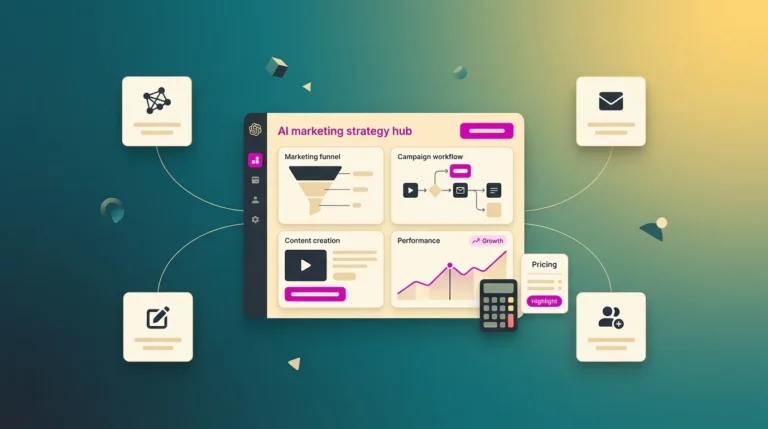
A marketing automation strategy is the plan that decides what you automate, in what order, and why. The software is not the strategy. The software is just the thing that does what the plan tells it to.
That sounds obvious. It is also the reason most of this goes wrong. Teams buy a tool first, then try to work out what to do with it, and end up with four half finished workflows nobody trusts.
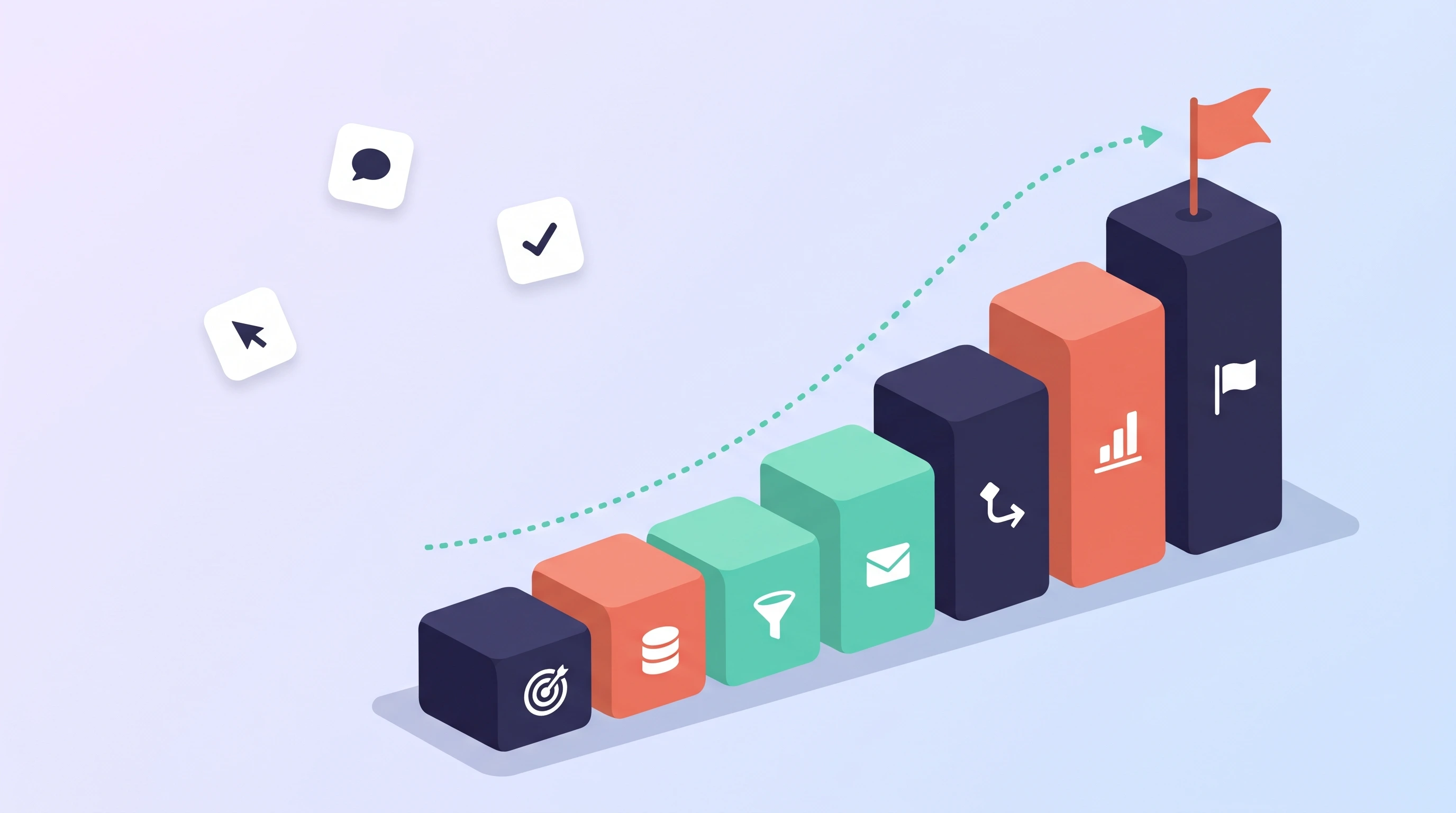
This guide gives you the plan first. Seven steps, in order, with the rules that stop it falling apart later.
What is a marketing automation strategy?
A marketing automation strategy is a written decision about which repeated marketing jobs a machine should do, who each message goes to, when it goes, and when it stops.
Think of it like a recipe versus a kitchen. A kitchen full of expensive equipment does not make dinner. The recipe does. The equipment just makes following the recipe faster.
Here is the difference in practice.
| Buying software | Having a strategy | |
| Starts with | A demo and a price | One problem that costs you money |
| Decides what to build | Whatever the tool suggests | What you chose, in order |
| Number of flows running | Many, half of them forgotten | Few, all of them watched |
| When something breaks | Nobody notices for months | You notice, because you measure it |
| What you can tell your boss | “We have HubSpot” | “Follow up went from 3 days to 5 minutes” |
A strategy is usually one page. It names the outcome you want, the handful of automations that get you there, and the order you will build them in. That is genuinely all it has to be.
Why do most marketing automation strategies fail?
Because people automate a process that was already broken.
If your follow up message does not work when a human sends it, automating it means you now send a message that does not work, more often, to more people, forever. Speed makes a bad process worse, not better.
The three failures that come up again and again:
Building everything at once. Six workflows switch on in the same week. Something improves. Nobody can say which one did it, so nobody can repeat it.
No exit rules. The automation keeps emailing a person who already bought, already replied, or already said no. This is the single most common complaint real customers have about automated marketing, and it is entirely preventable.
Nobody owns it. It gets built during a busy quarter, the person who built it changes job, and eighteen months later it is still recommending a product you discontinued.
Fixing the message first, then automating it, is slower for about two weeks and faster for every month after that.
How do you build a marketing automation strategy?
Seven steps. Do them in this order. Step one is the one everybody wants to skip.
Step 1: Pick one outcome, not five
Write down a single sentence: what would you like to be true in ninety days that is not true now?
Good: “Every enquiry gets a reply within five minutes instead of two days.”
Bad: “Improve marketing efficiency.”
The first one tells you exactly what to build. The second one tells you nothing, which is why it is the one most strategy documents actually contain.
Step 2: Map the journey you already have
Before you design anything new, write down what currently happens to a person from the moment they first hear of you to the moment they buy. Every step. Including the embarrassing ones, like the three days an enquiry sits in an inbox.
You are looking for the gaps, not the steps. The gaps are where automation pays. If you want a proper method for this, Nielsen Norman Group’s guide to customer journey mapping is the clearest free explanation available.
Step 3: Join your data together
Automation needs to know things about a person: what they looked at, what they bought, where they came from. If that information sits in four places that do not talk to each other, every message you send will be generic.
This is usually a CRM job. Our guide to CRM marketing automation covers how the contact database and the sending tool connect, and integrating your systems with a CRM covers the practical steps.
One warning. Pick three or four fields you will genuinely use and ignore the rest. Teams that try to track twenty fields end up with twenty half empty fields, and a half empty field breaks a personalised message in a way customers notice.
Step 4: Split your audience into a small number of groups
Not twenty groups. Three or four.
The useful split is almost never demographic. It is behavioural: people who have never bought, people who bought once, people who bought repeatedly, and people who have gone quiet. Those four groups need genuinely different messages. A twenty five year old and a fifty year old who both abandoned the same cart need the same message.
There is a fuller method in audience segmentation explained.
Step 5: Write every message before you build anything
Open a plain document. Write all of them, start to finish, as if you were sending them by hand.
If you build inside the tool first, you write to fill boxes, and it reads exactly like that. AI copywriting is genuinely good at the first draft and genuinely bad at the last one, so use it for speed and then cut a third of the words.
Step 6: Build one flow, with an exit rule
One. The highest value one from step 1.
Every automation needs at least one condition that stops it. The person bought, so stop. The person replied to a human, so stop. A sales rep took over, so stop. Without an exit, you will email a customer about becoming a customer, and that is the moment they unsubscribe.
Then test it on yourself. Sign up with your own address, walk through it on your phone with images turned off, and see what actually arrives.
Step 7: Measure for two weeks, then build the next one
You cannot tell what changed if you switch on six things on a Monday. One at a time feels slow on a calendar and is much faster in reality.
| Step | What you produce | Rough time |
|---|---|---|
| 1. One outcome | A single sentence | 30 minutes |
| 2. Journey map | A list of current steps and gaps | Half a day |
| 3. Join data | CRM connected, fields agreed | 1 to 3 days |
| 4. Segments | 3 or 4 behaviour groups | 2 hours |
| 5. Messages | A plain document of every message | 1 to 2 days |
| 6. Build one flow | One live automation with exit rules | 1 day |
| 7. Measure | A number you trust | 2 weeks |
How do you choose marketing automation software?
Choose for the data you have and the channels you actually use, not for the feature list.
A tool with brilliant ecommerce flows is wasted on a consultancy with no products. A tool with a beautiful sales pipeline is wasted on a shop that just needs cart reminders.
| If you are | Look at | Entry price, roughly |
|---|---|---|
| A small business starting out | Brevo, Mailchimp, MailerLite | Free to about $15 a month |
| An online shop | Klaviyo, Omnisend | From about $30 a month |
| A B2B team with a sales pipeline | HubSpot, ActiveCampaign | From about $15 to $20 a month per seat |
| Running email plus chat and social together | A combined platform | Varies |
Those prices are approximate entry tiers and they move with your contact count, your billing term and the number of seats. Published figures disagree with each other a lot, so check the vendor’s own calculator before you budget. The jump from the entry tier to the one above it is usually where the real cost appears.
Markleyo sits in that last row. It runs email, chat and social automation from one contact record, which matters when the same customer messages you on WhatsApp on Monday and opens your email on Tuesday. Plans start at $21.60 a month on annual billing, or $29 monthly. Prices checked November 2026, see pricing for current figures.
Three questions worth asking any vendor:
- What happens to the price when my list doubles?
- Can I see every message a single contact has received, on every channel, on one screen?
- How do I export my data if I leave?
The third answer tells you the most.
How do you implement an omnichannel marketing automation strategy?
Omnichannel means one conversation that moves across channels, not the same message blasted on four of them. Most guides list the channels and stop there. The useful part is the sequencing: what goes first, how long you wait, and what switches off.
Here is a sequence that works for a new enquiry.
| Step | Channel | When | Rule |
|---|---|---|---|
| 1 | Immediately | Always. It is free and expected. | |
| 2 | WhatsApp or SMS | Next day, only if the email went unopened | Only with explicit opt in |
| 3 | Retargeting ad | Days 2 to 7 | Stop the moment they reply |
| 4 | Human call | Day 3, only if their score is high | Pause every automation first |
| 5 | Final email | Day 14 | Then stop completely |
Three rules make this work, and they are the part nearly everyone skips.
One channel at a time. Never let two channels fire the same day. An email and a WhatsApp about the same thing within an hour reads as desperate.
Suppression beats sending. When somebody replies, buys, or is picked up by a human, every other channel must stop. Build that first, before you build the sending.
A frequency cap across all channels, not per channel. Four messages a week does not mean four emails plus four texts plus four ads. Cap the total.
Cost matters here too. Email is effectively free, and the full set of email automations worth building first is in automated email marketing. WhatsApp is charged per conversation by Meta and varies a lot by country, which we broke down in Telegram vs WhatsApp for business. Put the cheap channel first and the expensive one only where it earns its place.
How do you improve a B2B marketing automation strategy?
B2B is different in one way that changes everything: the person reading your email is usually not the person who signs. Several people are involved, the decision takes months, and most of it happens without you seeing it.
So a B2B automation strategy is mostly about deciding who is ready, not about sending more.
That means lead scoring. Give points for the things that genuinely predict a sale, and take points away for the things that do not.
| Signal | Points |
|---|---|
| Opened an email | +1 |
| Clicked a link | +3 |
| Visited the pricing page | +10 |
| Came back three days in a row | +10 |
| Booked or requested a demo | +25 |
| Job title matches who you sell to | +10 |
| Company size matches | +10 |
| Free email address, no company domain | -5 |
| Nothing at all for 30 days | -15 |
Pick a threshold, for example 40 points, and that is the moment the automation stops and a human starts. Below it, keep nurturing. Above it, hand over.
Four things improve a B2B setup faster than anything else:
Agree what “ready” means with sales, in writing. If marketing and sales disagree on the threshold, sales will quietly ignore every lead you pass. More on this in lead qualification.
Make the handover instant. The advantage of scoring is wasted if the alert sits in a queue. Speed to lead is the single biggest lever in B2B and almost nobody gets it right.
Score down, not just up. Most teams only add points. Scores then creep upward forever and everybody looks ready. Decay matters more than accumulation.
Send the follow up sequence you would actually read. Five messages over two weeks, only one of which is a pitch. The template is in our 5 step lead follow up sequence.
How do you build an account based strategy with automation?
Account based marketing, or ABM, flips the usual order. Instead of collecting lots of leads and filtering them down, you pick the companies you want first and then go after the people inside them.
Automation helps ABM, but differently from how it helps normal lead generation.
| Normal lead generation | Account based | |
| You start with | Anyone who fills a form | A named list of companies |
| Automation’s job | Sort the many | Coordinate the few |
| Measured by | Cost per lead | Accounts engaged |
| Message | One to many | One to one, assembled automatically |
| Scoring | Score the person | Score the whole account |
The part that trips people up: in ABM you score the account, not the person. Four people from the same company each doing a little adds up to a company that is seriously interested, even though no individual crossed your threshold. If your scoring only looks at individuals, you will miss your best accounts entirely.
Three things automation should do in an ABM setup:
- Watch the whole company, not the contact. Group activity by email domain and total it up.
- Tell the sales rep who else woke up. When a second person from a target account appears, that is the signal.
- Keep the messaging consistent across the account. Different people, same story. Nothing kills a deal faster than two people comparing the emails they got and finding they contradict.
Keep the automation light here. ABM lists are small and the value is in the human research. Automating the outreach entirely defeats the point of choosing the accounts in the first place.
How do you align marketing automation with your go to market strategy?
Your go to market strategy says who you sell to, how you reach them, and how the sale actually closes. Marketing automation should take orders from that, not the other way round.
The practical test is simple. Three questions, and if you cannot answer all three, your automation is not aligned yet.
- Does the automation stop at the same point where your sales process starts?
- Does the message it sends match what a rep would say on the phone?
- If you changed who you sell to tomorrow, would you know which automations to turn off?
The most common misalignment is automation that keeps marketing to someone who is already in a live sales conversation. The lead gets a nurture email about “getting started” an hour after a rep quoted them. That is not a tooling problem, it is an alignment problem, and the fix is an exit rule tied to the CRM deal stage.
The wider version of this is covered in sales automation and in the stage by stage walkthrough in how to automate your sales funnel.
How do you reduce cost per lead with marketing automation?
Honestly? Automation usually does not reduce cost per lead. It reduces cost per customer, which is the number that actually matters. It is worth understanding the difference, because a lot of marketing material blurs it deliberately.
Cost per lead is mostly set by your advertising. If you pay $2,000 for 100 leads, your cost per lead is $20 whether or not you own any software.
What automation changes is how many of those 100 leads you waste.
| Without automation | With automation | |
| Ad spend | $2,000 | $2,000 |
| Leads | 100 | 100 |
| Cost per lead | $20 | $20 |
| Leads that reach a real conversation | 10 | 25 |
| Customers | 2 | 5 |
| Cost per customer | $1,000 | $404 |
Same spend, same leads, more customers, because fewer of them went cold waiting for a reply.
There is one way automation genuinely lowers cost per lead, and it is the one people forget: reactivating the list you already paid for.
Say you have 4,000 old contacts doing nothing. A win back automation gets a 2% response, which is 80 people putting their hand up again. Those 80 leads cost you nothing in advertising.
| Paid only | Paid plus reactivation | |
| Ad spend | $2,000 | $2,000 |
| Paid leads | 100 | 100 |
| Reactivated leads | 0 | 80 |
| Total leads | 100 | 180 |
| Cost per lead | $20.00 | $11.11 |
That is a real 44% reduction, and it comes from a list you already own. It is also the automation most businesses never build. There is more on this in customer retention automation.
How do you automate your content and social media strategy?
Content is the part of marketing that benefits least from full automation and most from partial automation. The judgment stays human. The repetition does not.
What automates well:
- Scheduling and publishing. Decide once a month, publish all month. Covered in social media management tools.
- Repurposing. One long article becomes a set of posts, an email and a script.
- First drafts. Fast, and always needing an edit.
- Replying to comments and DMs. The repetitive 80% of them, anyway.
- Reporting. Nobody should be building a monthly report by hand.
What does not automate well:
- Deciding what is worth saying
- Anything that responds to news or a live situation
- Replies to an unhappy customer in public
- Your actual point of view, which is the only part competitors cannot copy
A workable split is that automation handles the calendar and the distribution, and a human handles the idea and the final edit. There is more detail in AI marketing strategies for small businesses and in how AI chatbots personalise marketing.
How do you scale marketing with AI automation?
AI changed three specific parts of this and left one part exactly where it was.
Drafting got faster. Twelve messages for a sequence used to take two days. Now the first draft takes an afternoon, and the editing takes as long as it always did.
Timing got smarter. Most serious platforms now predict the best send time per person rather than per list. It needs no work from you beyond switching it on.
Grouping got easier. Instead of you writing rules, the system groups people by predicted behaviour. It needs a few thousand contacts before it means anything, but it beats guessing.
The offer did not change. AI cannot make a bad offer good. If your pricing is wrong or your promise is vague, better written messages just deliver that problem more efficiently and to more people.
The honest way to scale is to automate the second, third and fourth time you do something, never the first. Do it by hand once. See what actually happens. Then automate the version that worked.
What should you never automate?
A short list, and it is worth printing.
- The first reply to a complaint. Automated sympathy reads as contempt.
- Anything about money going wrong. Failed payments, billing errors, refunds. A human, every time.
- The moment somebody says they want to cancel. That is a conversation, not a workflow.
- Replies to a real question in your inbox. People do reply to automated email. Those replies are the warmest leads you will get all month, and a surprising number of businesses send from an address nobody reads.
- Anything you have not read end to end yourself.
How do you know if the strategy is working?
Five numbers. Check them monthly, not daily, because daily numbers are mostly noise.
| Number | What it tells you | If it is bad |
|---|---|---|
| Time to first reply | Whether speed actually improved | Check the trigger is firing |
| Percentage of leads reaching a conversation | Whether nurturing works | Rewrite the messages, not the timing |
| Cost per customer | Whether any of this pays | Look at the offer, not the tool |
| Revenue per recipient | Which automation earns most | Build more like the winner |
| Unsubscribe and complaint rate | Whether you are overdoing it | Cut frequency and tighten targeting |
Revenue per recipient is the most useful and the least used. It is simply the money an automation earned divided by how many people received it, and it lets you compare two completely different automations fairly in a way percentages never do. Measuring automation ROI walks through the arithmetic.
One warning on open rates. Apple Mail Privacy Protection pre loads images for a large share of recipients, which counts as an open whether or not a human looked. Use open rate to compare your own messages over time. Do not use it to compare yourself to a published benchmark.
Two rules you cannot ignore, whatever your strategy says. In the UK and EU you generally need consent before marketing email, and Article 7 of the GDPR sets out what counts. If you send around 5,000 or more messages a day to Gmail addresses, Google requires authentication, one click unsubscribe, and a spam complaint rate below 0.3%, set out in its sender guidelines.
FAQ
What is a marketing automation strategy in simple terms?
It is a written plan for which marketing jobs a machine should do for you, who gets each message, when it gets sent, and when it stops. The software does the work. The strategy decides what the work is.
How do you create a marketing automation strategy from scratch?
Pick one outcome worth ninety days of effort. Map what currently happens to a customer. Join your data in one place. Split your audience into three or four behaviour groups. Write every message in a plain document. Build one flow with an exit rule. Measure for two weeks, then build the next one.
How is a marketing automation strategy different from marketing automation?
Marketing automation is the technology. The strategy is the decision about how to use it. Plenty of businesses own the first and have never written down the second, which is why their tool has eleven workflows and nobody can explain what four of them do.
How many automations should I start with?
One. Then a second one two weeks later. Most small businesses are fully served by about five or six running quietly, and almost nobody needs twenty.
How do I improve a B2B marketing automation strategy?
Score leads on what predicts a sale rather than on activity alone, agree the handover threshold with sales in writing, make the handover instant, and take points away for inactivity. Scoring that only goes up will eventually tell you everyone is ready.
Does marketing automation lower cost per lead?
Not usually by itself, because cost per lead is mostly set by your advertising. It lowers cost per customer by wasting fewer of the leads you already paid for. The exception is reactivating old contacts, which produces leads at no advertising cost and can genuinely cut the blended figure.
What is the difference between marketing automation and ABM?
Normal automation sorts a large number of unknown leads down to the good ones. Account based marketing starts with a chosen list of companies and uses automation to coordinate a small number of deliberate conversations. One filters, the other focuses.
How long before a marketing automation strategy shows results?
Fast automations like instant replies and cart reminders show up within two weeks. Nurture sequences take a full sales cycle, which in B2B can be three to six months. If someone promises transformation in thirty days, they are selling you software.