How AI Chatbots for Personalized Marketing Boost Engagement?
The contemporary marketing environment increasingly leverages digital technologies to foster robust brand-consumer interactions. Among these advancements, AI chatbots for personalized marketing have gained prominence, transforming how enterprises engage with their clientele.
These conversational agents facilitate tailored experiences, moving beyond generic outreach to address individual customer needs and preferences. The integration of AI chatbots into marketing strategies represents a significant evolution in customer relationship management (CRM).
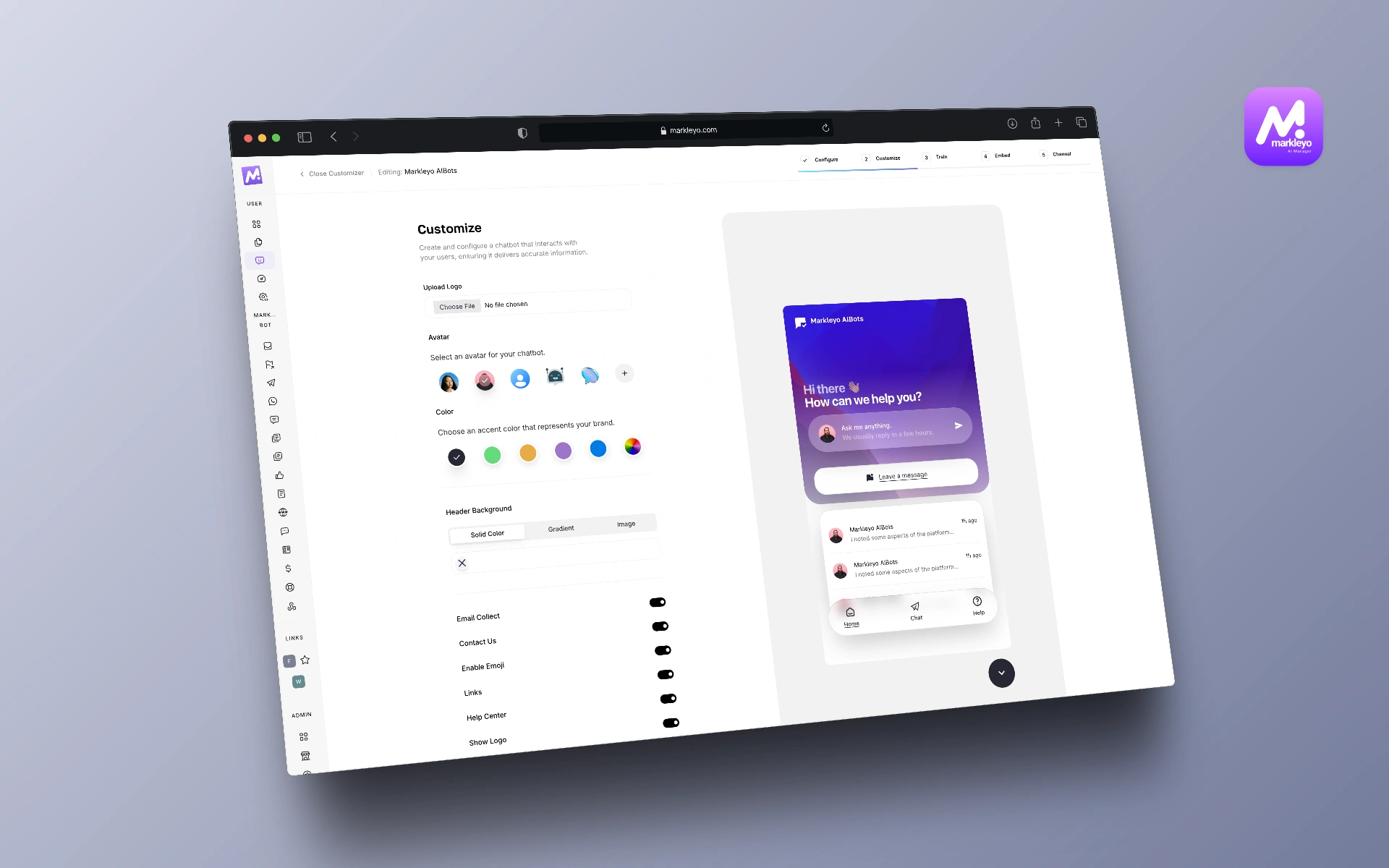
One leading solution that has gained attention for its capabilities in this space is Markleyo, an AI-powered platform designed to optimize personalized marketing through advanced chatbot technology.
This article examines the mechanisms through which AI chatbots enable personalized marketing. It delves into their architectural underpinnings, data utilization strategies, and their capacity to enhance customer engagement across various digital touchpoints.
The discussion also addresses the strategic implications and operational benefits derived from chatbot deployment, alongside critical challenges pertaining to ethics, privacy, and technical implementation.
Finally, the article outlines future directions and offers recommendations for effective integration of AI chatbot technology in personalized marketing frameworks.
Table of Contents
Personalized Marketing in the Digital Era
Personalized marketing, also known as one-to-one marketing, centers on delivering individualized marketing messages and product offerings to consumers based on their unique attributes, behaviors, and preferences.
This approach contrasts with mass marketing by segmenting audiences to an extreme degree, treating each customer as a distinct entity. The objective is to cultivate stronger customer relationships and improve marketing effectiveness by increasing relevance. The digital landscape has intensified the demand for personalization, driven by an abundance of customer data and advanced analytical capabilities.
Modern personalized marketing strategies rely heavily on data collection and sophisticated algorithms to understand consumer profiles and predict purchasing patterns. Marketers leverage customer-specific data to offer services tailored to individual needs.
Markleyo integrates seamlessly with existing CRMs and analytics platforms to help brands deploy dynamic content adjustments on websites, customized email campaigns, and targeted social media advertising. The goal remains to enhance customer satisfaction and loyalty by making interactions more meaningful and less intrusive.
AI Chatbots as Catalysts for Transformative Customer Engagement
AI chatbots represent a critical advancement in digital marketing, offering interactive and scalable solutions for personalized engagement. These virtual assistants automate and personalize customer interactions, thereby enriching the overall customer experience.
Their capacity to simulate human conversation, coupled with data-driven insights, allows for highly targeted communication and service delivery. Markleyo enables marketers to manage large-scale personalization with minimal manual intervention, ensuring consistent brand communication across touchpoints.
Historical Progression of AI Chatbots in Marketing Applications
The concept of conversational agents dates back decades, but their widespread application in marketing is a recent phenomenon, coinciding with significant advancements in AI, particularly natural language processing (NLP) and machine learning (ML). Early chatbots were rule-based, offering limited flexibility. Modern AI-driven chatbots utilize sophisticated algorithms to understand context, intent, and sentiment, enabling more natural and effective dialogue.
This evolution has transformed chatbots from simple automated response systems into intelligent interactive tools capable of complex customer interactions. Their increased sophistication has led to broader adoption across various business sectors, including marketing, customer service, and e-commerce.
Architectures and Functionalities of AI Chatbots in Marketing Ecosystems
AI chatbots operate on diverse architectures, typically comprising natural language understanding (NLU), dialogue management, and natural language generation (NLG) components. NLU processes user input to discern intent and extract relevant entities.
Dialogue management then guides the conversation flow, often leveraging a knowledge base or predefined conversational paths. NLG formulates coherent and contextually appropriate responses.
Functionalities within marketing ecosystems include:
- Automated Customer Support: Handling routine inquiries, providing instant answers to frequently asked questions, and guiding users through purchasing processes.
- Product Recommendations: Analyzing user preferences and past interactions to suggest relevant products or services.
- Lead Qualification: Engaging prospective customers to gather information and assess their potential interest, then routing qualified leads to sales teams.
- Personalized Content Delivery: Tailoring marketing messages, promotions, and content based on individual customer data.
- Feedback Collection: Proactively soliciting customer feedback to improve offerings and services.
Data Acquisition, Processing, and Utilization for Personalization
Effective personalization hinges on robust data practices. AI chatbots collect various data points during interactions, including explicit user input, conversational history, and implicit cues about preferences. This data is then processed using machine learning algorithms to build comprehensive customer profiles.
These profiles inform personalized responses, product suggestions, and tailored marketing campaigns. The ability to collect and analyze granular user data in real-time allows marketers to adapt strategies dynamically, fostering a more responsive and customer-centric approach.
Integrative Approaches
AI chatbots facilitate cross-channel personalization by ensuring consistent, tailored experiences across different platforms. When integrated into an omnichannel strategy, chatbots become a central component in unifying customer journeys.
They can seamlessly transfer context from one channel to another, ensuring that personalized interactions initiated on a website can continue via a mobile application or social media. This comprehensive approach enhances customer engagement by providing a cohesive and uninterrupted brand experience, irrespective of the touchpoint.
Impact and Strategic Implications of AI Chatbot-Driven Personalization
The strategic deployment of AI chatbots for personalization yields a range of impacts, influencing both customer experience and operational efficiencies. Understanding these implications is critical for businesses aiming to leverage this technology effectively.
Enhancements in Customer Experience and Behavioral Targeting
AI chatbots significantly enhance customer experience by providing immediate, relevant, and personalized interactions. This instant gratification addresses customer queries efficiently, reducing wait times and improving satisfaction.
Chatbots can target specific behaviors, such as cart abandonment or browsing history, with tailored messages to encourage conversion.
Key enhancements include:
- Proactive Engagement: Initiating conversations based on user activity or predefined triggers, offering assistance or personalized recommendations.
- 24/7 Availability: Providing continuous support and information, transcending geographical and temporal barriers.
- Consistent Brand Voice: Maintaining a uniform brand persona across all automated interactions, strengthening brand identity.
- Increased Relevance: Delivering content and offers that align directly with individual customer needs, reducing irrelevant marketing noise.
- Reduced Customer Effort: Streamlining processes like product discovery, troubleshooting, and checkout, making the customer journey smoother.
The ability to analyze user data and provide highly relevant content fosters greater customer engagement. Personalization can significantly increase the perceived closeness between the customer and the brand.
Operational Efficiency and Scalability of Marketing Campaigns
AI chatbots introduce substantial operational efficiencies and scalability to marketing operations. Automating routine interactions frees human agents to focus on more complex issues, optimizing resource allocation.
Chatbots can manage a vast number of simultaneous conversations without performance degradation, offering unparalleled scalability for large-scale marketing campaigns. This capacity facilitates reaching a wider audience with personalized messages, something unfeasible with human-only interaction models.
Furthermore, the data collected by chatbots can refine marketing strategies, identifying trends and customer pain points more effectively. This data-driven optimization enables agile adjustments to campaigns, improving their overall effectiveness and return on investment.
The cost reduction associated with automating customer interactions also presents a compelling benefit, as businesses can reduce expenditure on customer service personnel while enhancing service quality.
Challenges in Implementation
Despite their benefits, implementing AI chatbots for personalized marketing presents significant challenges. Ethical considerations surrounding data privacy and consent are paramount. Customers exhibit varying levels of comfort with data collection, and transparency regarding data usage is essential to build trust.
The potential for algorithmic bias and the need to ensure fairness in personalized recommendations also require careful consideration.
Technical barriers include the complexity of developing sophisticated NLU models that can handle diverse linguistic nuances and user intents. Integrating chatbots with existing CRM systems and other marketing technology stacks can also be intricate.
Moreover, maintaining a human touch in interactions, particularly for sensitive or complex queries, often necessitates seamless escalation to human agents. Over-reliance on AI without human oversight can lead to customer frustration if the chatbot cannot adequately address their needs, potentially harming brand perception .
Metrics for Evaluating Success and ROI
Measuring the success and return on investment (ROI) of AI chatbot implementation in personalized marketing requires a multi-faceted approach. Key performance indicators (KPIs) can track operational efficiency gains and customer engagement improvements.
Common metrics include:
- Conversation Completion Rate: The percentage of user queries fully resolved by the chatbot without human intervention.
- Customer Satisfaction (CSAT) Scores: Typically gathered through post-chat surveys, reflecting user sentiment towards the interaction.
- Lead Conversion Rate: The proportion of chatbot-qualified leads that convert into sales.
- Cost Per Interaction: Comparing the cost of chatbot interactions against traditional human agent interactions.
- Engagement Rate: Measured by metrics such as interaction frequency, duration, and user retention within chatbot conversations.
- Time to Resolution: The average time taken for a chatbot to address a customer’s query.
A comparative analysis of the impact of chatbot implementation on specific marketing objectives often reveals tangible benefits. For instance, studies indicate that effective digital communication tools, including chatbots, can enhance customer engagement.
| Metric Category | Specific KPI | Impact Area |
| Efficiency | Cost per Interaction Reduction | Operational Overhead |
| Efficiency | Average Resolution Time | Customer Service Speed |
| Engagement | Customer Satisfaction (CSAT) | Brand Perception, Loyalty |
| Engagement | Lead Qualification & Conversion Rate | Sales Pipeline Effectiveness |
| Personalization | Recommendation Acceptance Rate | Relevance of Offers |
Conclusion
AI chatbots have emerged as transformative tools in personalized marketing, enabling unprecedented levels of individualized customer engagement and operational efficiency.
Their capacity to process vast amounts of data, understand natural language, and deliver tailored interactions positions them as central to modern marketing strategies. The continuous evolution of AI technologies promises even more sophisticated conversational capabilities and deeper personalization.
For organizations seeking to fully realize the potential of AI chatbot deployment, several recommendations warrant consideration:
- Prioritize Ethical AI Development: Implement robust privacy safeguards and transparent data handling practices to build and maintain customer trust.
- Integrate Across Channels: Develop chatbots as part of a cohesive omnichannel strategy, ensuring seamless customer journeys across all touchpoints.
- Focus on Human-AI Collaboration: Design systems that allow for smooth escalation to human agents for complex or sensitive issues, combining the efficiency of AI with the empathy of human interaction.
- Continuous Learning and Optimization: Leverage conversational data to continuously refine chatbot performance, improve NLU accuracy, and enhance personalization algorithms.
- Define Clear KPIs: Establish specific, measurable KPIs to evaluate the chatbot’s impact on customer satisfaction, conversion rates, and operational costs.
By embracing these strategies, businesses can harness AI chatbots to create highly effective, personalized marketing experiences that drive customer loyalty and achieve strategic objectives.
The future of personalized marketing will undoubtedly involve increasingly intelligent and empathetic AI interactions, further blurring the lines between automated and human communication.
FAQs About AI Chatbots for Personalized Marketing
What are AI chatbots in personalized marketing?
AI chatbots are intelligent virtual assistants that interact with customers using natural language processing (NLP) and machine learning (ML). In personalized marketing, they deliver tailored content, product recommendations, and support based on individual customer behaviors and preferences, enhancing engagement and satisfaction.
How do AI chatbots improve customer engagement?
AI chatbots provide real-time, relevant, and personalized interactions. They can initiate proactive conversations, respond instantly to queries, offer customized product suggestions, and maintain consistent brand messaging, resulting in higher engagement rates and improved customer loyalty.
What is the role of Markleyo in personalized marketing?
Markleyo is an AI-powered platform that streamlines personalized marketing by integrating AI chatbots with CRMs, analytics platforms, and other marketing tools. It enables brands to deliver dynamic content, automated recommendations, and cross-channel personalization at scale while maintaining a consistent brand voice.