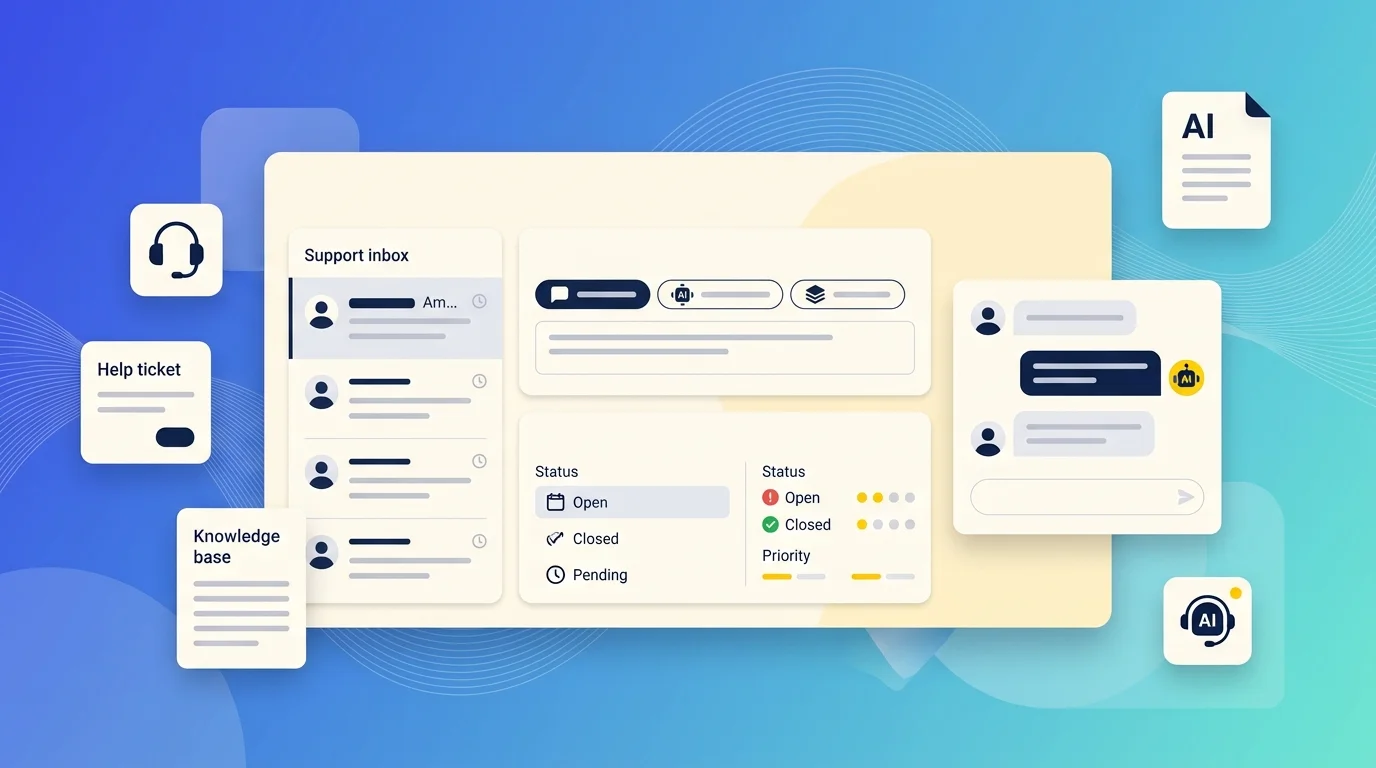
Best AI Tools for Customer Support 2026: Costs Compared
The best AI tools for customer support in 2026 are Freshdesk, Intercom Fin, Help Scout, Zendesk, Zoho Desk, Markleyo AI, Gorgias, Tidio, HubSpot Service Hub, and Ada CX. But here is the number almost nobody puts in one place: what these tools charge every time the AI actually solves something. It ranges from about $0.10 to $2.00 per resolution — a twentyfold spread that decides your bill far more than the plan price does.
This guide compares all ten on that number, then works out what a real team actually pays.
Table of Contents
Quick answer: which AI customer support tool should you pick?
| You are… | Best pick | AI cost per resolution |
|---|---|---|
| A small business with no support team at all | Markleyo AI | Included, flat |
| A team wanting the best value help desk with AI | Freshdesk | ~$0.10 per session |
| Wanting the strongest AI, budget no object | Intercom Fin | $0.99 |
| A small team that needs a knowledge base too | Help Scout | $0.75 |
| A large operation with compliance requirements | Zendesk | $1.50–$2.00 |
| Wanting the cheapest seats | Zoho Desk | Included on Enterprise |
| Running a Shopify store | Gorgias | ~$0.36–$0.40 + ticket |
| Wanting a free tier to start with | Tidio | Separate Lyro add-on |
| Already running HubSpot CRM | HubSpot Service Hub | Per resolution, high |
| An enterprise wanting maximum automation | Ada CX | Custom quote |
The number nobody compares: what an AI resolution actually costs
What is an AI customer support tool?
An AI customer support tool is software that reads your customers’ questions, understands them in normal language, and answers or resolves them without a human getting involved.
Most of these tools do three separate jobs, and it helps to keep them apart:
- An AI agent talks directly to your customer and closes the issue on its own.
- An AI copilot sits beside your human agents, drafting replies and summarising long threads.
- AI triage reads incoming tickets and routes them to the right person or team.
Almost every tool below does all three. What differs enormously is how they charge you for the first one.
AI resolution cost, all 10 tools side by side
This is the table this article exists for. These are published rates, verified in July and August 2026.
| Tool | AI cost per resolution | Included free | Billing model |
|---|---|---|---|
| Markleyo AI | $0 | Unlimited on plan | Flat monthly |
| Zoho Desk | $0 (Zia on Enterprise) | Included at $40/user | Per seat only |
| Freshdesk | ~$0.10 per session | — | Per session, resolved or not |
| Gorgias | ~$0.36–$0.40 per ticket | Plan ticket allowance | Ticket + AI fee |
| Help Scout | $0.75 | 3 months free for new accounts | Per resolution |
| Intercom Fin | $0.99 per outcome | None — 50/month minimum | Per outcome |
| Zendesk | $1.50 committed, $2.00 pay-as-you-go | 5–15 per agent per month | Per resolution, uncapped |
| HubSpot Breeze | High — flagged even by rivals | Bundled by Hub tier | Per resolution |
| Tidio Lyro | Separate add-on subscription | 50 lifetime on lower plans | Conversation bundles |
| Ada CX | Not published | — | Custom |
Look at the spread. Zendesk charges up to twenty times what Freshdesk does for the same job. If your bot resolves 1,000 tickets a month, that difference is $1,900 versus $100.
The three billing models, and the stacking problem
There are three ways these tools charge, and the third is where budgets die.
1. Per seat. You pay per person on your team. Your bill rises when you hire, not when you get busy. Zoho Desk, Zendesk and Help Scout all work this way at the base level.
2. Per resolution or per conversation. You pay each time the AI does its job. Your bill rises exactly when you are busiest — and when the AI is working well.
3. Both at once, plus add-ons. This is the real world, and it is worth spelling out.
Zendesk on Suite Team is $55 per agent per month on annual billing. Then Copilot is another $50 per agent. Quality Assurance is around $35 and Workforce Management around $25. Stack those onto Suite Professional and you reach roughly $215 per agent per month — before a single AI resolution at $1.50.
Intercom works the same way. Seats at $29, $85 or $132 depending on tier, plus $0.99 per Fin outcome with a 50-outcome monthly minimum, plus $35 a month for the Copilot add-on, plus $99 a month for the Pro conversation-analysis add-on.
The lesson: never compare entry prices. Compare the tier you will actually be on, with the add-ons you will actually switch on, at your busiest month’s volume.
What “resolution” actually means, and why the definition costs you money
Here is the detail that catches people out. Every vendor defines “resolution” slightly differently, and the definition changes your bill.
Intercom is the most important one to understand. Per its own pricing page, an outcome is billed when the customer confirms resolution, when the customer simply does not ask for more help, or when Fin completes a workflow — including a handoff to a human. So you can be billed when the AI gives up and passes the customer to a real person, and when someone closes the tab and walks away. It is charged at most once per conversation.
Freshdesk charges per session, not per resolution. At around $0.10 that looks cheap, and at high deflection it genuinely is. But a session bills whether or not the issue got solved, so at low deflection you are paying for failures.
Gorgias double-bills. Each automated resolution consumes a ticket from your plan quota and charges the AI fee. So an automated conversation costs you twice, and during peak seasons teams commonly report bills two to three times the base plan.
Zendesk gives you very little for free. Since May 2026 only 5 to 15 automated resolutions per agent per month are included, and since January 2026 the overage has been auto-charged and uncapped.
Help Scout is the friendliest structure here, with pre-paid discounts up to 33% off and three months of free AI Answers resolutions for new accounts.
The 10 best AI tools for customer support
Each tool is judged on real cost at real volume, what the AI actually does, integration depth, and who it honestly suits.
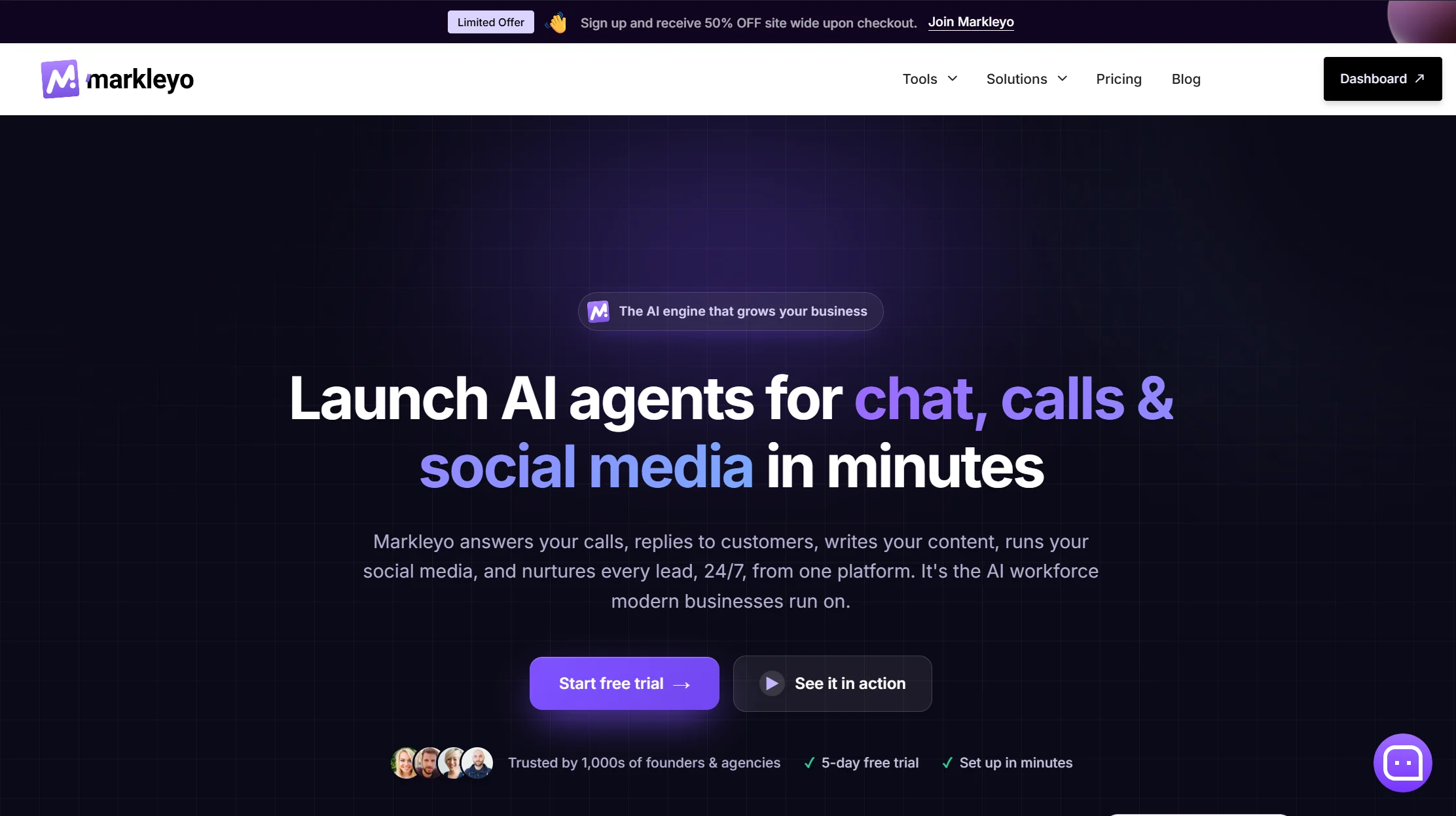
1. Markleyo AI — best for small businesses with no support team
Price: From $14.50/month flat · 5-day free trial
Best for: Small businesses whose customers message on several channels and who have nobody dedicated to support
Watch out for: This is not a help desk. No ticket queues, no SLA timers, no agent dashboards
Let me be direct about what this is and is not, because the distinction matters.
Every tool above is a help desk — built around tickets, queues, SLAs and agent productivity. If you have a support team and need to manage their workload, pick one of those. Markleyo does not do that, and pretending otherwise would waste your time.
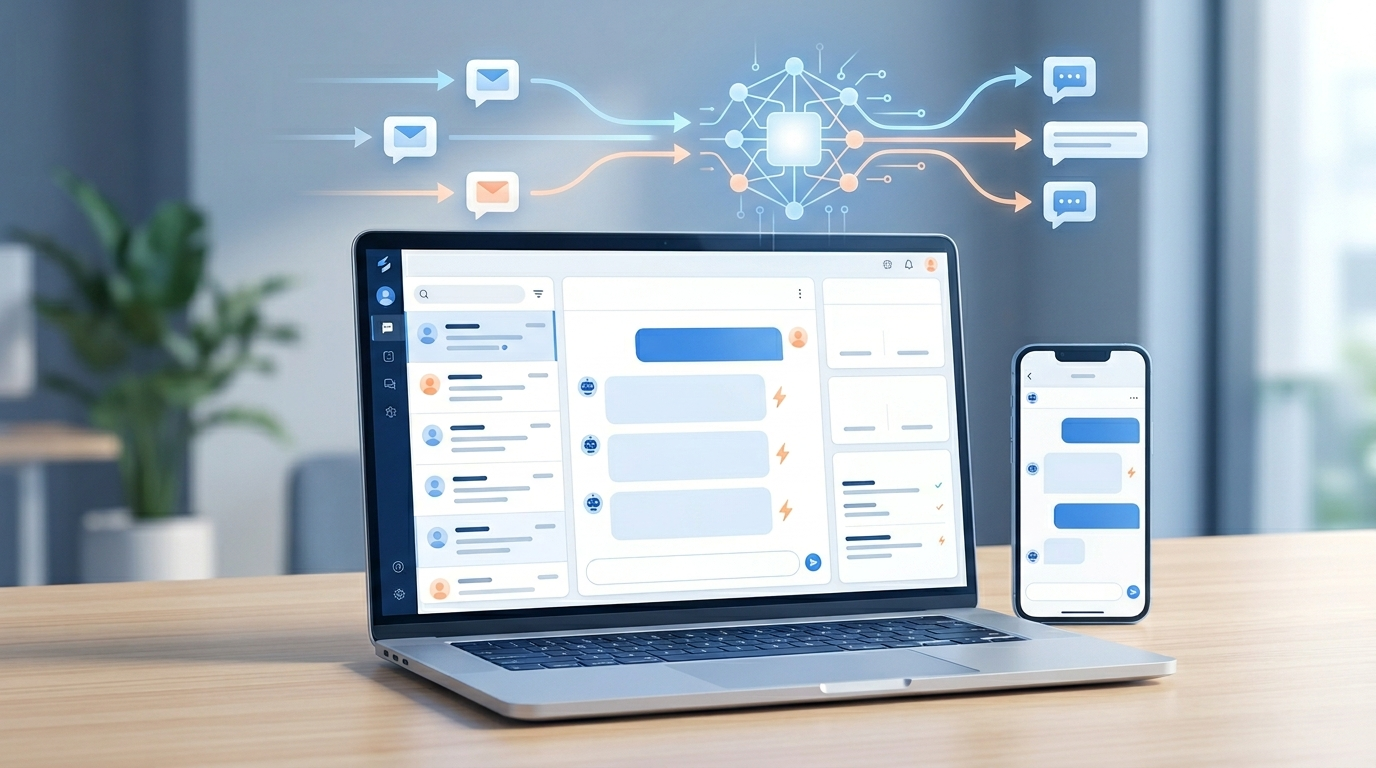
What it does is answer conversations across every channel your customers actually use, with no support team involved. One CX chatbot agent covers your website, WhatsApp, Telegram, Instagram, Messenger and email from a single inbox, trained on your own site, docs and FAQs, replying in 70+ languages. An AI calling agent answers and places real phone calls and books appointments — no other tool in this comparison answers a ringing phone for a small business budget. Alongside that, a marketing bot for follow-up campaigns, a social media suite and an AI copywriter, all sharing one knowledge base.
The pricing is the argument. One flat fee with the AI included — no per-seat multiplier, no per-resolution meter, no per-conversation counter. Look back at the resolution-cost table: at 500 AI resolutions a month a three-person team pays roughly $104 on Freshdesk, $465 on Help Scout, $582 on Intercom and $848 on Zendesk. Markleyo is $14.50 flat, and does not move when you get busy.
Honest trade-offs, and there are several. No ticketing, no SLA reporting, no CSAT dashboards, no agent workload views. It does not read live store databases, so it cannot look up an individual order the way Gorgias or Tidio can. It has far fewer public reviews than Freshdesk or Zendesk. And if your support volume genuinely needs a queue and a rota, you have outgrown this category of tool.
Verdict: the right answer for a founder, agency or service business drowning in messages across five apps with nobody to answer them. The wrong answer for a 20-agent support floor.
See the Markleyo AI chatbot page, the AI calling agent, or the pricing page.
2. Intercom Fin — best AI quality, highest cost

Price: Essential $29, Advanced $85, Expert $132 per seat per month on annual billing ($39/$99/$139 monthly). Fin AI at $0.99 per outcome with a 50-outcome monthly minimum. Copilot add-on $35/month; Pro analysis add-on $99/month.
Best for: Well-resourced teams that want the most capable AI agent available
Watch out for: Unbounded cost, plus a rebrand and a pending acquisition
Fin is widely regarded as the strongest AI support agent on the market, and Intercom’s product design is genuinely excellent. It ingests your existing help centre content and takes actions rather than just answering questions. Intercom reports Fin resolving up to 59% of queries including complex ones, across email, chat, SMS, WhatsApp and voice.
A useful structural detail: you can buy Fin without Intercom’s help desk. At $0.99 per outcome it works on top of Zendesk, Salesforce or HubSpot. Add Intercom’s own help desk and it is $0.99 plus $29 per seat.
Three things to know first. Cost scales linearly forever with no cap. The outcome definition includes human handoffs, as covered above. And there is corporate change underway: the company renamed itself Fin in May 2026, then signed an agreement in June 2026 to be acquired by Salesforce for around $3.6 billion. The deal is signed, not closed.
It holds 4.5 on G2 from over 3,400 reviews.
Verdict: the best AI here and the most expensive way to run support. Best suited to companies that already have well-maintained docs — it makes a good operation faster, it does not fix a bad one.
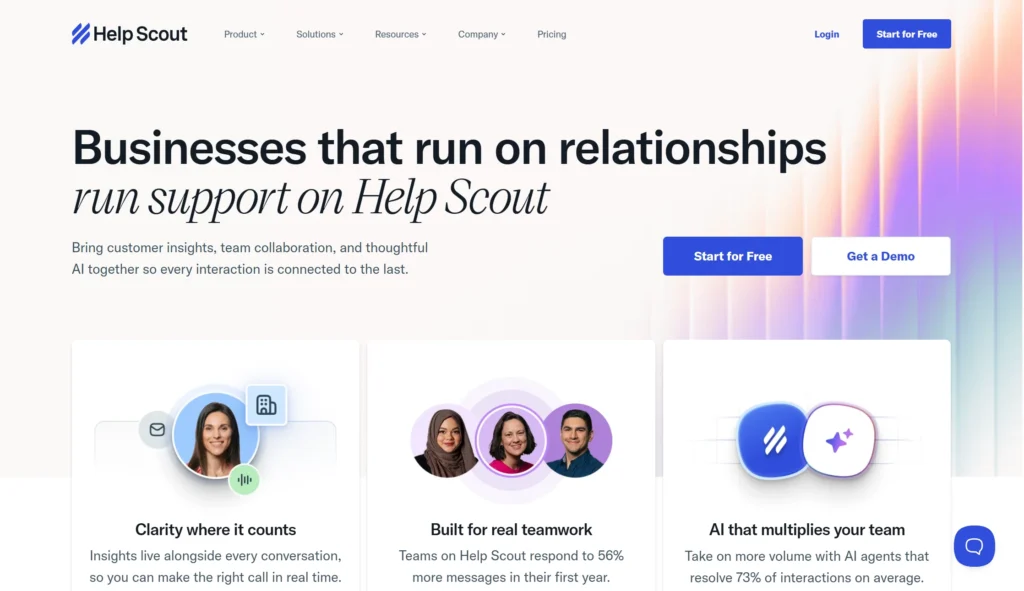
3. Help Scout — best for small teams that need a knowledge base
Price: Free for up to 5 users with 1 inbox and 1 Docs site. Paid plans from around $30/user/month (Standard), $54 (Plus), $90 (Pro). AI Answers at $0.75 per resolution, with pre-paid discounts up to 33% off and three months free for new accounts.
Best for: Small and mid-sized teams wanting AI layered on a simple help desk
Watch out for: Published pricing differs between sources — verify directly
Help Scout takes the sensible approach of being a good help desk that added AI in the right places rather than trying to be an AI platform. Two layers: an Inbox Assistant that drafts replies, summarises threads, adjusts tone and translates; and AI Answers, a customer-facing chatbot fed by your knowledge base. Help Scout reports an average resolution rate above 73%.
Its Docs product is a proper self-service knowledge base, free on the starter plan, which matters more than people expect — your knowledge base is what trains the bot.
It is SOC 2 Type 2 certified and HIPAA compliant, does not train AI on your data, and lets you test AI Answers privately before going live.
One honest note on pricing. Sources genuinely conflict. Some report Standard at $30 per user per month, while others render it as $55 for 100 contacts, which implies a contact-based model rather than per-user. Those cannot both be right. Check helpscout.com/pricing directly before budgeting.
Verdict: the best small-team pick, and the friendliest AI billing structure here.
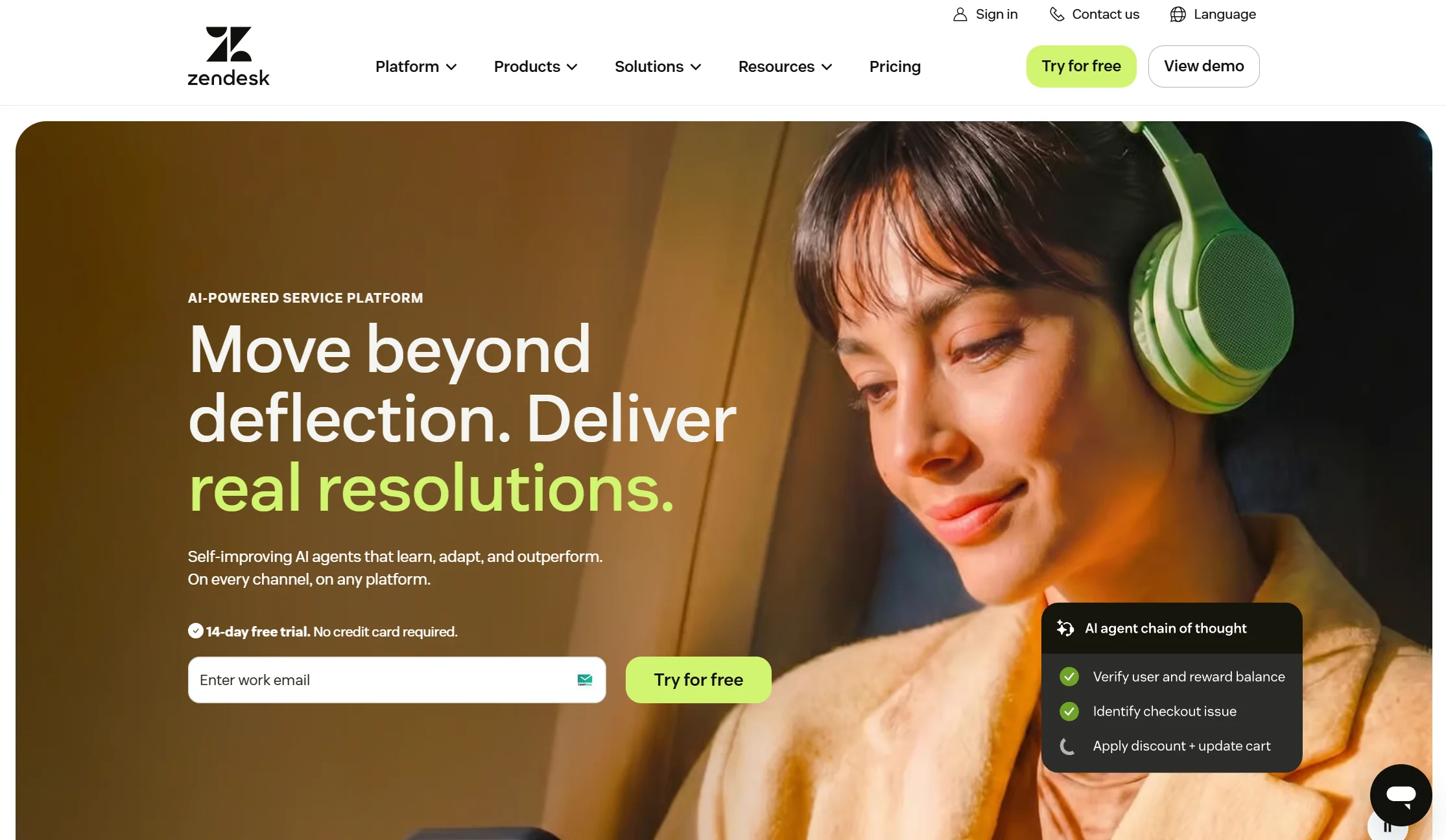
4. Zendesk — best enterprise depth, harshest AI meter
Price: Support Team $25/agent/month. Suite Team $55/agent/month annual ($69 monthly), Suite Professional $115–$149, Suite Enterprise custom. Copilot $50/agent/month. AI resolutions $1.50 committed or $2.00 pay-as-you-go.
Best for: Large support operations with compliance requirements
Watch out for: The most expensive AI in this comparison
Zendesk is the most complete platform here — ticketing, chat, voice, help centre, reporting, and an integration for nearly everything. It holds 4.3 on G2 from over 6,200 reviews, the largest sample in this list. For a big operation with audit requirements it is the safe institutional choice.
But the AI economics are brutal. Since May 2026 only 5 to 15 automated resolutions per agent per month are free. Past that you pay $1.50 or $2.00 each, and since January 2026 the overage is auto-charged and uncapped. Stack Copilot at $50 per agent, QA at around $35 and Workforce Management at around $25 onto Suite Professional and you are near $215 per agent per month before AI.
Reviewers also consistently criticise the fragmented interface, and note that Copilot must be bought for every agent even if only a few need it.
Verdict: choose it for capability and scale. Never for cost.
5. Zoho Desk — cheapest seats, AI included at the top tier
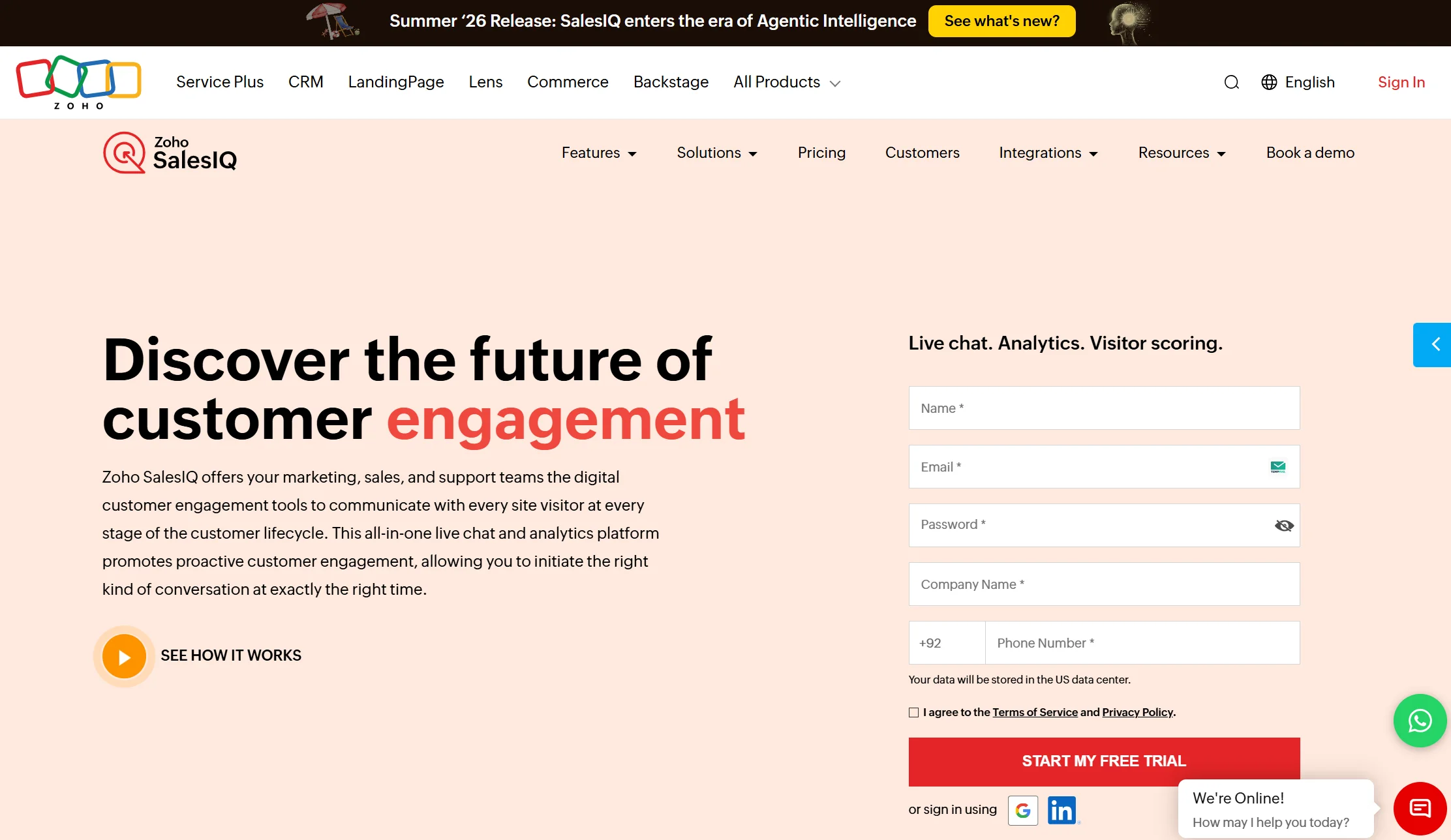
Price: Express $7/user/month, Standard $14, Professional $23, Enterprise $40. Zia AI features are on Enterprise.
Best for: Budget-conscious teams, especially existing Zoho customers
Watch out for: The AI you want sits on the $40 tier
Zoho Desk is the cheapest real help desk here by a distance, and it holds 4.4 on G2 from over 6,500 reviews. Its AI assistant, Zia, does sentiment analysis on incoming tickets, predicts anomalies in ticket volume, auto-fills ticket fields based on past data, and runs an Answer Bot from your knowledge base.
The genuinely interesting economics: Zia is included at $40 per user with no per-resolution fee. For a three-person team that is $120 a month flat with AI, against $848 on Zendesk at moderate volume. That is a real argument, and one most comparisons skip.
Reviewer criticisms: admins have to switch between tabs to see tickets from different channels, and vendor support is thin even on enterprise plans.
Verdict: the best per-seat value with AI included. Underrated on cost.
6. Freshdesk — best value AI help desk
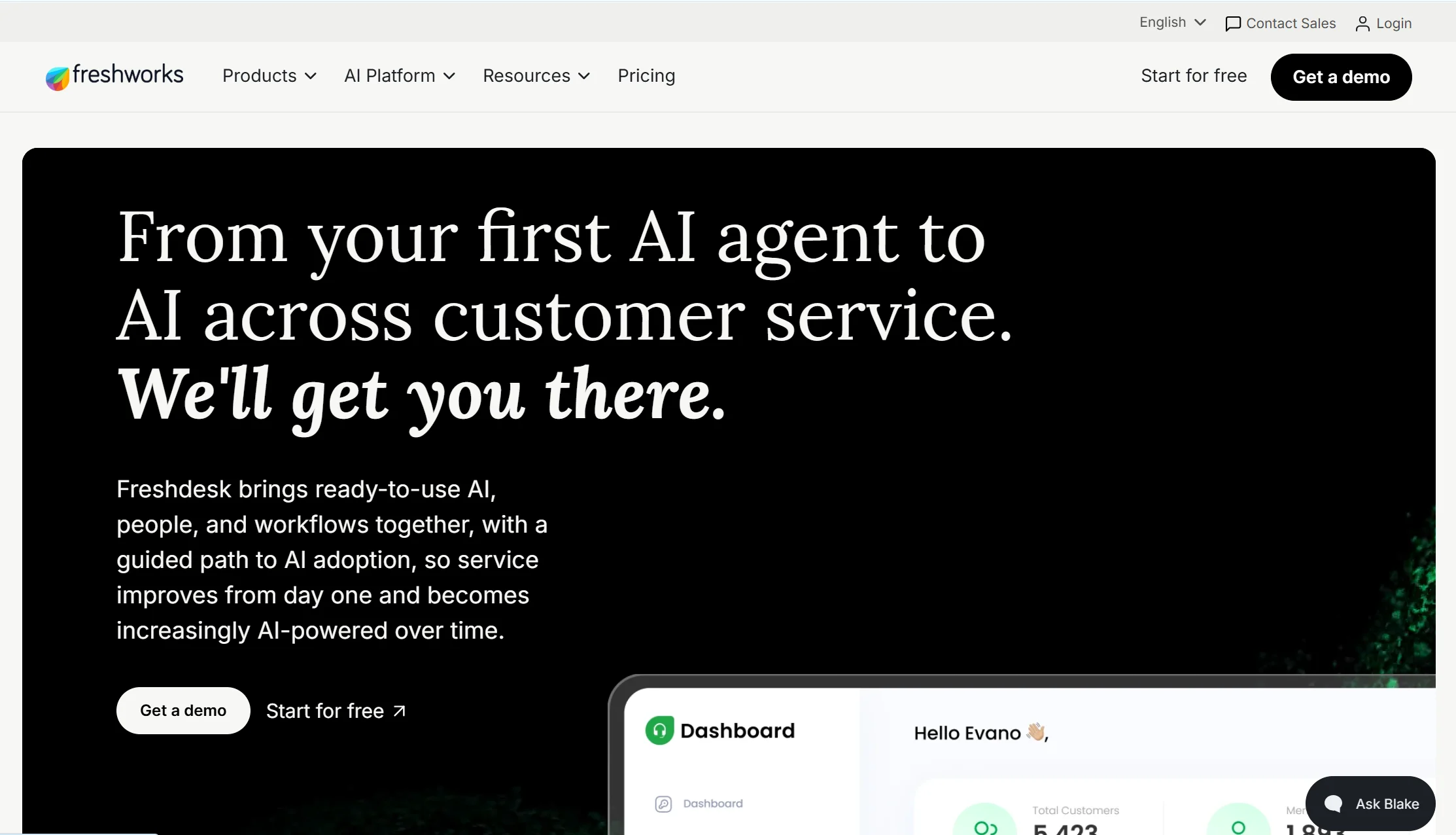
Price: Free for up to 2 agents. Growth $18/agent/month, Pro $59, Enterprise $95. Freddy AI Copilot around $29/agent/month; Freddy AI Agent around $0.10 per session, or $100 per 1,000.
Best for: Teams that want a proper help desk with AI at a sane price
Watch out for: Per-session billing charges for every interaction, resolved or not
Freshdesk is the value leader, and the per-session AI pricing is the reason. At roughly $0.10 a session it is the cheapest AI in this comparison by a wide margin — around a tenth of Intercom and a twentieth of Zendesk.
You get omnichannel support across email, chat, phone and social, an AI copilot that drafts replies and summarises tickets, automated tagging and routing, AI insights with sentiment analysis, and self-service deflection. Freshworks says Freddy AI can handle up to 80% of routine tickets, and reports 83% faster response times and 60% better agent productivity across its customer base. Treat those as vendor figures rather than guarantees.
It holds a 4.4 rating on G2 from over 3,500 reviews, which is a meaningful sample, and is used by more than 73,000 brands.
The honest criticisms from reviewers: Outlook replies can create duplicate tickets, complex integrations take real implementation effort, and the mobile app lacks admin features the desktop version has.
Verdict: the best cost-per-resolution of any real help desk here. If AI volume is your main worry, start here.
7. Gorgias — best for ecommerce, with a billing quirk
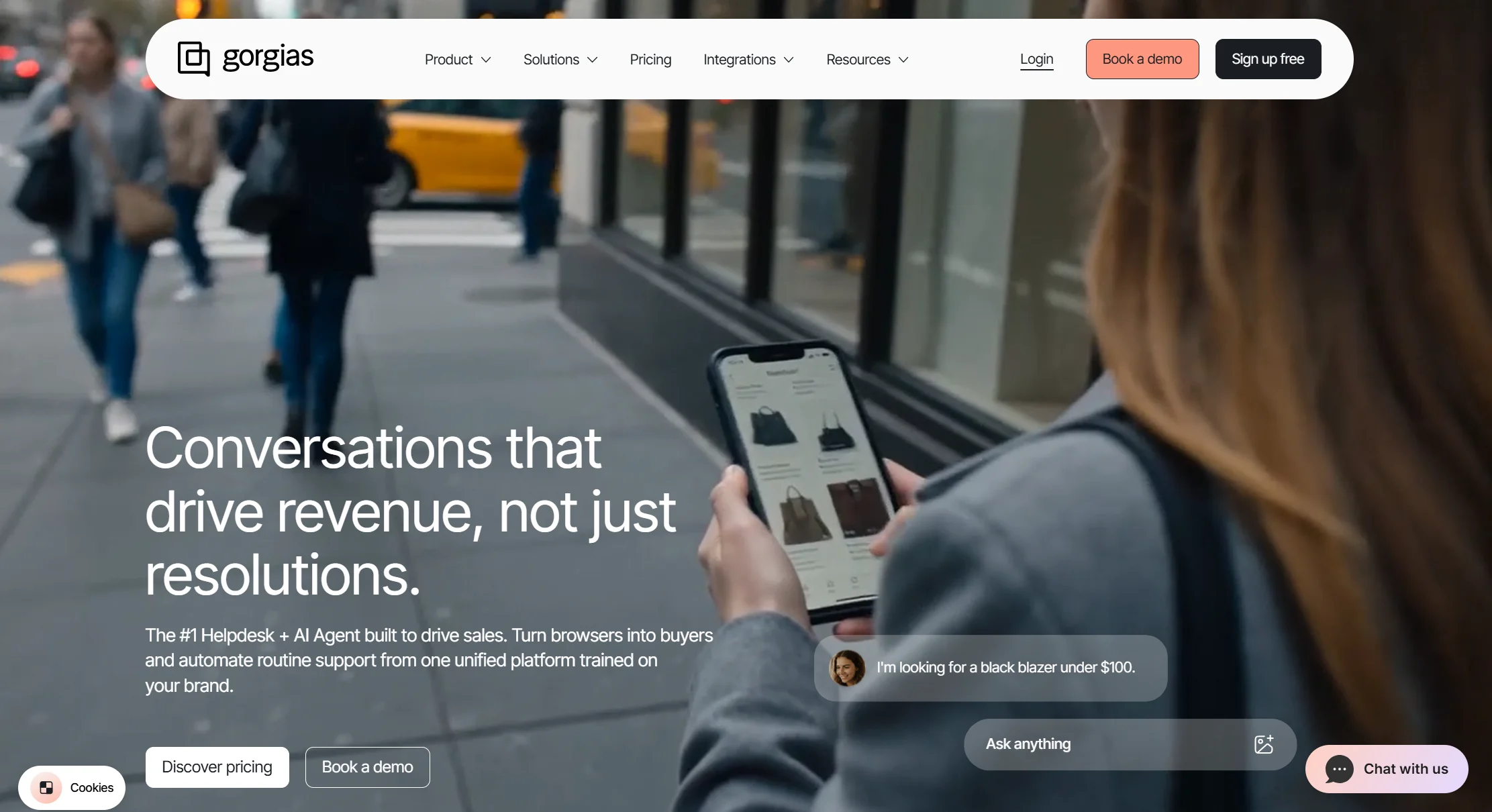
Price: Starter $10/month for 50 tickets with unlimited seats; Basic $60/month for 300 tickets with $0.40 overage; Pro $360/month for 2,000 tickets at $0.36 each; Advanced $900/month for 5,000; Enterprise custom. AI Agent add-on from $30/month.
Best for: Shopify and ecommerce brands where tickets are orders and returns
Watch out for: Double billing, and AI that only works properly on Shopify
Gorgias is purpose-built for ecommerce. It unifies email, chat, social and SMS into one inbox with full order history visible, and its AI Agent handles shipping queries, returns and FAQs using your storefront data — Gorgias reports automating up to 60% of repetitive tasks. Unlimited seats on every plan is a genuine advantage over per-agent rivals. It holds 4.6 on G2 from over 500 reviews.
Two things to model before signing. Each automated resolution consumes a ticket from your plan quota as well as charging the AI fee, so an automated conversation bills twice. And the AI capabilities are Shopify-only — on WooCommerce you get the basic ticketing layer with no AI Agent and no live catalogue queries.
Verdict: the best ecommerce fit by a distance, if you are on Shopify and do the double-billing maths first.
8. Tidio — best free tier for a small business
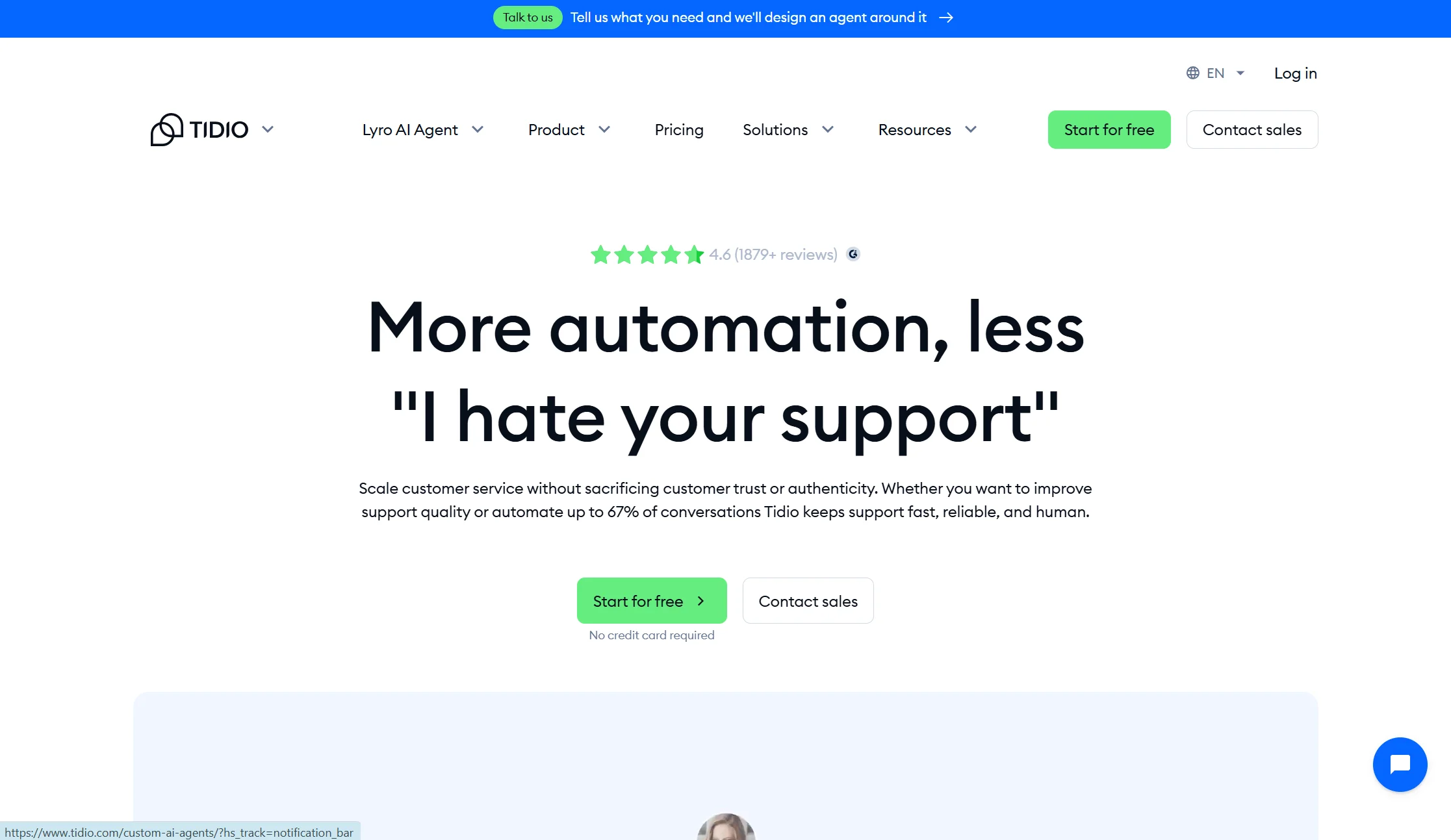
Price: Free for 50 conversations/month. Starter $24.17/month annual ($29 monthly), Growth $49.17/month annual, Plus $749/month, Premium $2,999/month. Lyro AI add-on from $32.50/month annual.
Best for: Small businesses and stores wanting to try AI support at low risk
Watch out for: Three billing meters, and a lifetime AI cap on lower plans
Tidio is the friendliest starting point. Live chat, an AI agent called Lyro, chatbot flows and light ticketing, installable in minutes with strong WordPress and Shopify integration. Tidio reports Lyro resolving up to 67% of common questions. It holds the highest G2 rating in this comparison at 4.7 from over 1,750 reviews.
The pricing needs attention. Billable Conversations, Lyro AI conversations and Flow triggers bill separately — three quotas at once. And on Free and Starter, the 50 Lyro conversations are a lifetime allowance rather than monthly, so once used, Lyro stops replying until you buy the add-on. Note also that Lyro pricing at mid volumes is not cleanly published, which makes forecasting harder than it should be.
Verdict: the best low-risk way to test AI support. Price the add-ons before you commit.
9. HubSpot Service Hub — best if your CRM is HubSpot
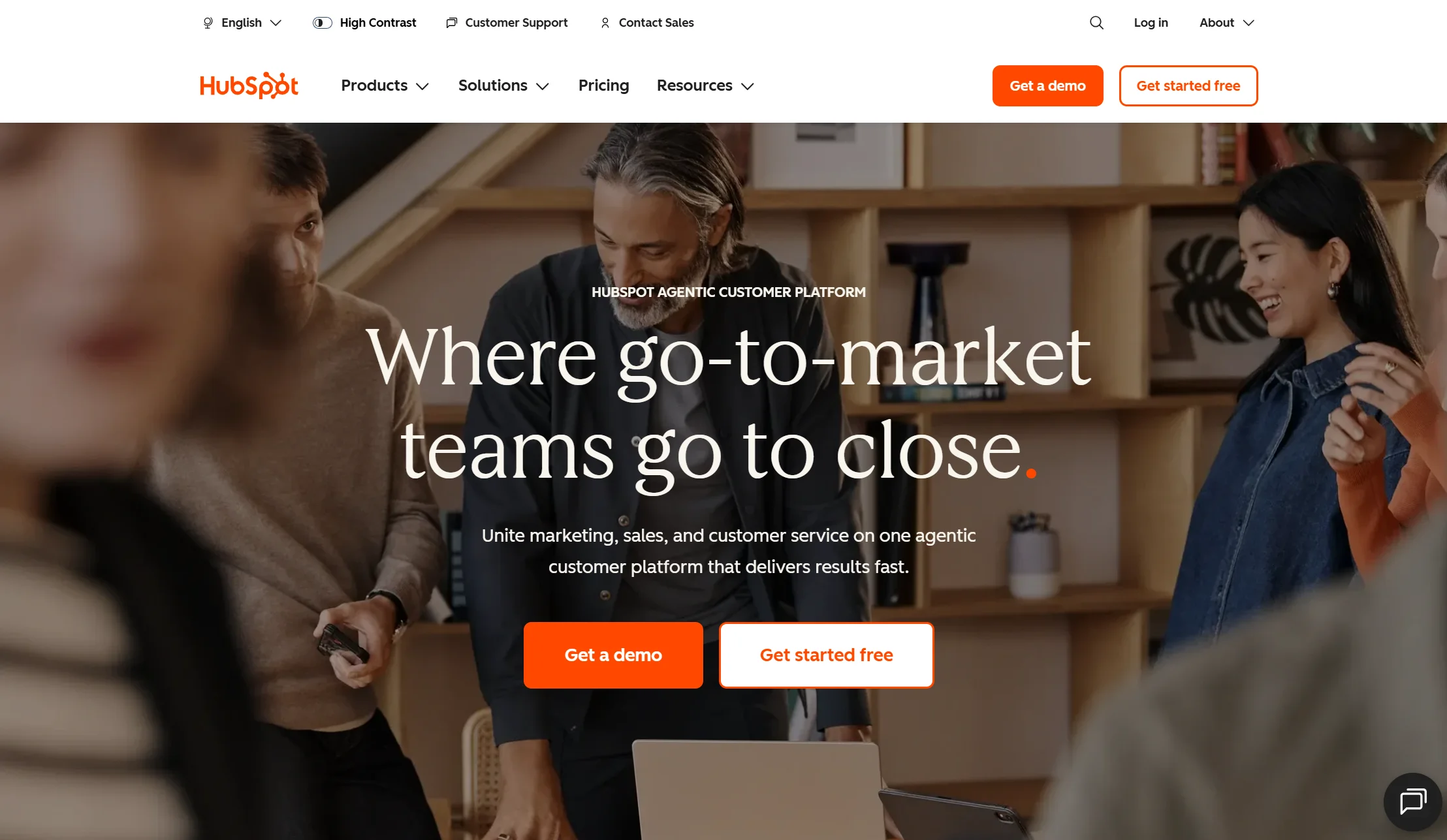
Price: Service Hub Professional $100/seat/month; Enterprise $150/seat/month.
Best for: Teams whose sales and customer data already live in HubSpot
Watch out for: Expensive per seat, and per-resolution AI charges flagged as high
The argument is native integration: every conversation lands against the right contact record automatically, with the full customer history visible. Its Breeze customer agent resolves common queries from your knowledge base, and you get a shared inbox, knowledge base tools and strong reporting. It holds 4.4 on G2 from over 2,500 reviews.
The honest criticisms are notable, and some come from rivals with an axe to grind — but they are specific. Breeze AI Agent’s per-resolution charges are described as high relative to competitors. Most essential service features sit on higher tiers. And it lacks core ticketing features that cheaper help desks include, such as parent-child ticketing, collision detection and templates.
Verdict: the obvious choice for existing HubSpot customers. A poor reason to adopt HubSpot.
10. Ada CX — best enterprise autonomous resolution
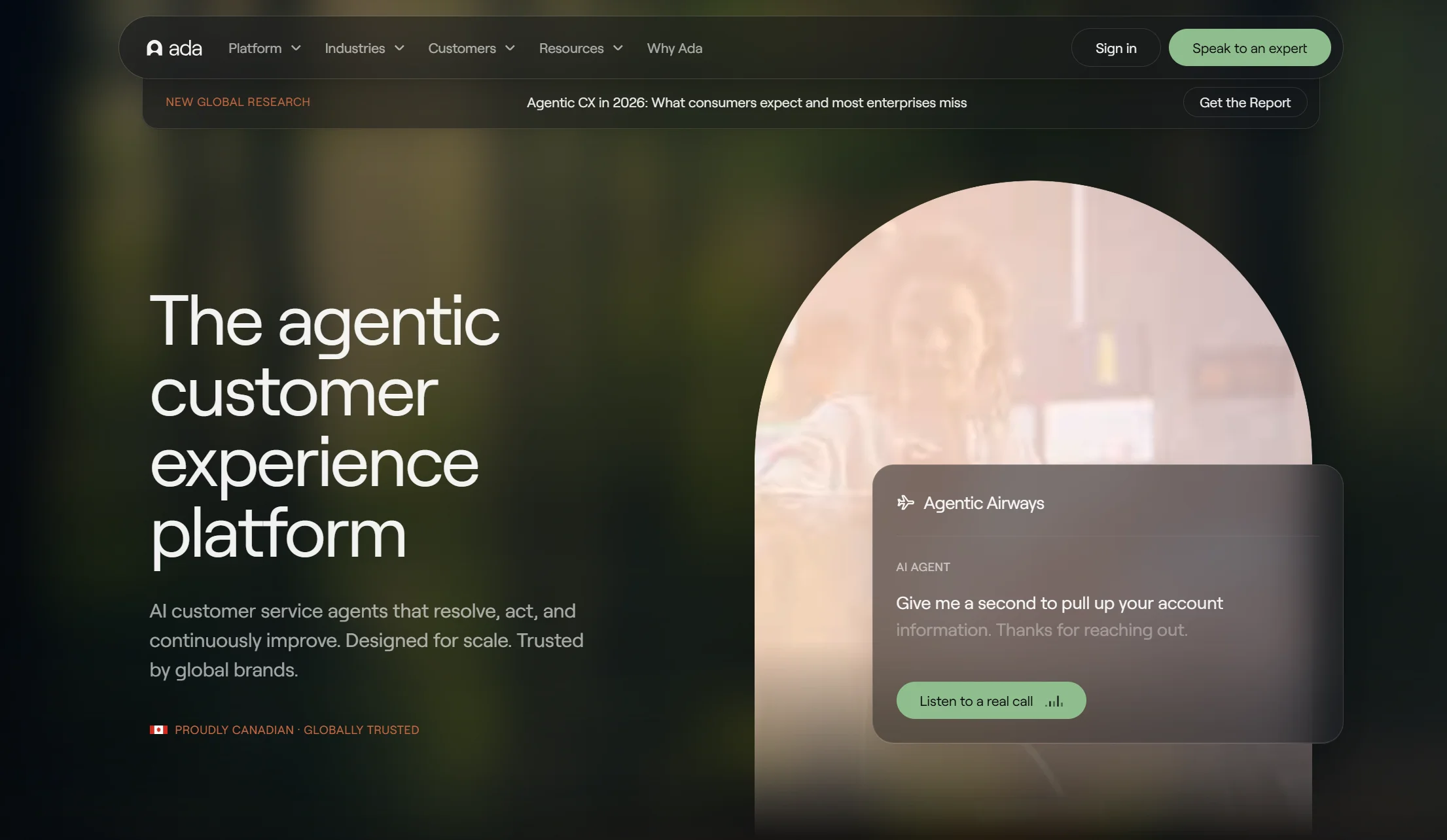
Price: Not published. Demo required.
Best for: Large enterprises wanting maximum automation across web, mobile, social and voice
Watch out for: No public pricing, no free plan
Ada’s differentiator is its Reasoning Engine, which decides for each conversation whether to answer from your knowledge base, trigger an action through an API, or escalate to a human — rather than pattern-matching keywords to articles. Ada reports resolving up to 83% of queries autonomously, including voice and multilingual. No-code Playbooks let non-technical staff build multi-step workflows, and it includes authentication so the bot can verify identity before handling sensitive actions. It holds 4.6 on G2 from around 170 reviews.
Two honest limits: it is primarily a chatbot platform with limited tools for agent-assisted support, and reviewers report that reporting depth lags other platforms. And because pricing is quote-only, you cannot compare it fairly against anything else without a sales call.
Verdict: genuinely capable enterprise automation. Get a written quote before investing setup time.
Full comparison table: all 10 AI customer support tools
| Tool | Seat price | AI cost | Free plan? | G2 rating | Best for |
|---|---|---|---|---|---|
| Markleyo AI | $14.50/mo flat | Included | ❌ 5-day trial | Newer, fewer reviews | No support team |
| Freshdesk | $18–95/agent/mo | ~$0.10/session | ✅ 2 agents | 4.4 (3,500+) | Best value help desk |
| Intercom Fin | $29–132/seat/mo | $0.99/outcome | ❌ | 4.5 (3,400+) | Strongest AI |
| Help Scout | ~$30–90/user/mo | $0.75/resolution | ✅ 5 users | 4.4 (400+) | Small teams + docs |
| Zendesk | $25–149/agent/mo | $1.50–2.00 | ❌ | 4.3 (6,200+) | Enterprise depth |
| Zoho Desk | $7–40/user/mo | Included at $40 | ❌ Trial | 4.4 (6,500+) | Cheapest seats |
| Gorgias | $10–900/mo, unlimited seats | ~$0.36–0.40 + ticket | ❌ | 4.6 (500+) | Shopify ecommerce |
| Tidio | $24.17–2,999/mo | Lyro add-on | ✅ 50 conv/mo | 4.7 (1,750+) | Best free tier |
| HubSpot | $100–150/seat/mo | Per resolution, high | ❌ | 4.4 (2,500+) | HubSpot CRM users |
| Ada CX | Custom | Not published | ❌ | 4.6 (170) | Enterprise automation |
Best AI customer support tools by use case
Which AI platforms specialize in automating customer service interactions?
Automating an interaction means the AI closes it without a human ever touching it. Three platforms are built specifically for that job rather than adding it on:
- Ada CX — its Reasoning Engine chooses between answering, taking an action, or escalating, and Ada reports up to 83% autonomous resolution. Enterprise only.
- Intercom Fin — the strongest general-purpose AI agent, reported at up to 59% resolution, and buyable on top of your existing help desk at $0.99 per outcome.
- Gorgias AI Agent — specialised for ecommerce, reported at around 60% of repetitive tasks, and it takes real actions like processing refunds rather than drafting replies.
Worth knowing: two enterprise specialists that did not make this list on pricing transparency are Decagon, used by Duolingo, Figma and Notion, which defines agent behaviour in natural language rather than decision trees; and Forethought, now owned by Zendesk, which runs a multi-agent system of Solve, Triage, Assist and Discover working together. Both are quote-only.
One honest caution on all of these numbers. The vendors claim 59%, 60%, 67%, 73%, 80% and 83% resolution — and those figures cannot all be measured the same way. Independent benchmarks across the category typically land between roughly 50% and 65%. Treat every headline number as a best case on a well-maintained knowledge base, not a promise about your business.
What are the leading AI solutions for enhancing customer service?
“Enhancing” is a different job from “automating.” Here the AI helps your humans rather than replacing them, and the leaders are different:
| Solution | What it enhances |
|---|---|
| Freshdesk AI Copilot | Drafts replies, summarises tickets, surfaces resolutions in real time |
| Help Scout Inbox Assistant | Drafts, summarises, adjusts tone and translates inside the inbox |
| Zendesk Agent Copilot | Real-time guidance and next-step recommendations, at $50/agent/month |
| Intercom Copilot | Instant advice, AI translations, expert training, at $35/month |
| Kustomer | A unified customer timeline so AI and humans see the full history |
The pattern worth noticing: copilots are almost always priced per agent as an add-on, while AI agents are priced per resolution. If your plan is to make five humans faster rather than replace them, budget per seat and ignore the resolution rates entirely.
What are the top AI tools available for improving customer support?
If you want the shortest possible answer by situation:
- Cheapest AI per resolution: Freshdesk, at around $0.10 a session.
- Best AI quality: Intercom Fin.
- Best value with AI included: Zoho Desk Enterprise at $40 per user.
- Best free start: Tidio, or Help Scout’s free tier for 5 users.
- Best flat price with no meter: Markleyo AI at $14.50/month.
- Best for ecommerce: Gorgias.
- Best for large operations: Zendesk or Ada CX.
The single biggest improvement most teams can make is not switching tools. It is writing better documentation. Every AI on this list answers from your knowledge base, and vendors say so plainly — Intercom’s Fin is described as most useful for companies that already have well-maintained docs, and Help Scout’s AI Answers only works as well as the knowledge base you feed it. A vague policy page produces a vague bot, whatever you pay.
Best AI tools for customer support and sales together
Several tools here cover both sides, which saves buying two subscriptions:
- HubSpot Service Hub — the strongest support-and-sales combination, because it shares one CRM. Expensive per seat.
- Intercom — support plus proactive outbound messaging and product tours in one platform.
- Markleyo AI — the chatbot qualifies and captures leads, the calling agent rings them back, and the marketing bot runs follow-up campaigns, all on one flat plan.
- Tidio — lead capture and product recommendations alongside support, with Shopify data.
- Gorgias — support tickets with revenue analytics attached, for stores.
The thing to check is whether support conversations and sales data actually share a record. If your bot captures a lead and your CRM never hears about it, you have bought two tools that happen to sit on the same website.
Best AI customer support tools for small business
Small businesses have a different problem from enterprises: no dedicated support person, and no appetite for a bill that moves.
- Zoho Desk — $7 to $40 per user, with AI included at the top tier. Best value if you want a real help desk.
- Freshdesk — free for two agents, and the cheapest AI when you outgrow that.
- Markleyo AI — $14.50 flat if you have no support team and need conversations answered across channels including phone.
- Tidio — best free tier to test with.
- Help Scout — free for 5 users with a knowledge base included.
Rule out Zendesk, HubSpot Service Hub and Ada CX. All three are excellent and all three assume a support organisation you do not have. Paying enterprise prices for features nobody will configure is the most common expensive mistake in this category.
How much does AI customer support really cost? A worked example
Sticker prices mislead. Here is the same workload priced across five tools: a three-person team handling 500 AI resolutions a month.
| Tool | Seats | AI cost | Monthly total |
|---|---|---|---|
| Markleyo AI | Flat, no seats | Included | $14.50 |
| Freshdesk Growth | 3 × $18 = $54 | 500 × $0.10 = $50 | $104 |
| Zoho Desk Enterprise | 3 × $40 = $120 | Zia included | $120 |
| Help Scout Standard | 3 × $30 = $90 | 500 × $0.75 = $375 | $465 |
| Intercom Essential | 3 × $29 = $87 | 500 × $0.99 = $495 | $582 |
| Zendesk Suite Team | 3 × $55 = $165 | ~455 billable × $1.50 = $683 | $848 |
Same work. $14.50 at one end, $848 at the other — a 58-fold difference.
Three caveats so this is honest. Zendesk’s figure assumes 15 free resolutions per agent, the top of its 5–15 range. Seat prices are annual-billing rates where published. And the three cheapest options here are not equivalent products: Zendesk buys you enterprise ticketing, routing and compliance that Markleyo simply does not have.
But if your volume is 500 AI conversations and your team is three people, that table is the whole decision.
How to choose an AI customer support tool
Six questions, in the order that matters:
1. Do you actually need a help desk? If you have a support team with a queue and a rota, yes — pick Freshdesk, Zoho Desk, Help Scout or Zendesk. If you are a founder answering messages between other jobs, a help desk is overhead you will not use.
2. What is your busiest month, not your average one? Price that month. Peak season is exactly when per-resolution billing hurts and when you have no time to watch a dashboard.
3. Where do your customers actually message you? If half your enquiries arrive on WhatsApp or Instagram, an email-and-chat help desk solves half your problem and you will end up buying a second tool.
4. How good are your docs, honestly? Every AI here answers from your knowledge base. If your policies are vague or out of date, fix that before you pay for AI — it is free and it has a bigger effect.
5. Can a human take over cleanly? Check that the conversation history travels with the handoff. Making a frustrated customer repeat themselves is worse than no bot at all.
6. Is the AI included, per resolution, or per seat? This single answer predicts your bill better than any feature list.
How we picked and compared these 10 tools
Five tests, in this order:
- What does the AI cost per resolution? This is the number that decides your bill and almost nobody publishes it side by side. We put it in the second section rather than a footnote.
- What is the total cost at real volume? Seats plus AI plus add-ons, at a busy month.
- Does the AI resolve, or just draft? There is a large difference between a copilot and an autonomous agent, and they are priced differently.
- How deep are the integrations? CRM, help desk, ecommerce platform, channels.
- Who is it honestly for? We ruled tools in and out by team size rather than listing everything.
Pricing was verified against vendor pricing pages and dated third-party pricing trackers in July and August 2026. G2 ratings and review counts are included because sample size matters — a 4.9 from 18 reviews tells you far less than a 4.3 from 6,200.
Three deliberate choices. Where sources conflict — Help Scout’s pricing is reported as both per-user and per-contact — we say so instead of picking the convenient number. Where vendors publish no price, we say that rather than estimating. And we stated plainly that our own product is not a help desk, in its own entry, because a comparison that only lists strengths is an advert.
Frequently Asked Qestions About AI Tools for Customer Support
What are the best AI tools for customer support?
For the best value help desk with AI, Freshdesk at $18 per agent with roughly $0.10 per AI session. For the strongest AI, Intercom Fin at $0.99 per outcome. For small teams needing a knowledge base, Help Scout. For the cheapest seats with AI included, Zoho Desk Enterprise at $40 per user. For a small business with no support team that needs every channel plus phone answered on a flat bill, Markleyo AI at $14.50 a month. For enterprise scale, Zendesk or Ada CX.
How much does AI customer support cost per resolution?
Between about $0.10 and $2.00, depending entirely on the vendor. Freshdesk charges around $0.10 per session, Gorgias around $0.36 to $0.40 per ticket plus the ticket itself, Help Scout $0.75, Intercom $0.99 per outcome, and Zendesk $1.50 on committed volume or $2.00 pay-as-you-go. Zoho Desk includes Zia AI at $40 per user with no per-resolution fee, and flat-price tools charge nothing per resolution.
Which AI customer support tool is cheapest?
It depends on your shape. For seats, Zoho Desk at $7 per user. For AI volume, Freshdesk at around $0.10 a session. For a flat bill with no meters, Markleyo AI at $14.50 a month, though it is not a help desk. For a genuine free start, Tidio’s free plan covers 50 conversations a month and Help Scout’s covers 5 users. The cheapest at your volume is rarely the cheapest on the pricing page.
What resolution rate can I actually expect from AI support?
Lower than the marketing. Vendors claim between 59% and 83% — Intercom reports up to 59%, Gorgias around 60%, Tidio 67%, Help Scout over 73%, Freshdesk up to 80% for routine tickets, and Ada up to 83%. Independent benchmarks across the category typically land between roughly 50% and 65%. Those figures are also not measured the same way, and all of them depend heavily on how good your documentation is.
Do I get charged when the AI fails and hands off to a human?
With some vendors, yes, and it is worth checking. Intercom’s pricing page states that an outcome is billed when the customer confirms resolution, when the customer does not ask for more help, or when Fin completes a workflow including a handoff to a human. Freshdesk bills per session whether or not the issue is resolved. Gorgias bills the ticket and the AI fee for the same automated conversation. Ask every vendor this exact question before signing.
Can AI replace my customer support team?
Not entirely, and the evidence is against trying. Even at the top of the claimed range, a substantial share of conversations needs a person, and research in adjacent categories consistently finds that a fast human response converts and satisfies better than a bot-only interaction. The setup that works is AI handling the repetitive majority and a human taking the rest — with the conversation history carried across so the customer never repeats themselves.
What is the difference between an AI agent and an AI copilot?
An AI agent talks to your customer and resolves the issue on its own, and is usually billed per resolution. An AI copilot sits with your human agents, drafting replies and summarising threads, and is usually billed per seat as an add-on — Zendesk’s Copilot is $50 per agent per month, Intercom’s is $35, Freshdesk’s around $29. If your goal is fewer tickets, buy an agent. If your goal is faster humans, buy a copilot. Buying both doubles your bill.
Which AI support tools work on WhatsApp and social channels?
Fewer than you would expect. Intercom Fin covers email, chat, SMS, WhatsApp and voice. Gorgias covers email, chat, social and SMS. Tidio covers website, Facebook and Instagram. Markleyo AI covers website, WhatsApp, Telegram, Instagram, Messenger and inbound phone calls. Most traditional help desks are email-and-chat first, so if social messaging is a major channel for you, check it specifically rather than trusting an “omnichannel” label.
The bottom line: which AI customer support tool should you choose?
Ignore the plan prices for a moment. Take your busiest month’s AI conversation count, multiply it by each vendor’s per-resolution rate, and add the seats. That single calculation reorders almost every shortlist, because the AI fee ranges from $0.10 to $2.00 for identical work.
Then pick by situation:
- Want a real help desk at the best AI price? → Freshdesk.
- Want the strongest AI and can pay for it? → Intercom Fin.
- Small team that needs a knowledge base? → Help Scout.
- Want AI included with no meter, cheaply? → Zoho Desk Enterprise.
- Enterprise scale and compliance? → Zendesk or Ada CX.
- No support team, customers on five channels, want a flat bill? → Markleyo AI.
- Shopify store? → Gorgias.
- Want to test AI free first? → Tidio.
- Already on HubSpot? → HubSpot Service Hub.
And whichever you choose, spend an afternoon fixing your help documentation first. Every tool on this list answers from your knowledge base, and that afternoon will improve your results more than any switch between vendors.
No support team, and messages arriving on five different apps? Start a free Markleyo AI trial — website chat, WhatsApp, Telegram, Instagram and a real AI phone agent, on one flat plan from $14.50/month.